
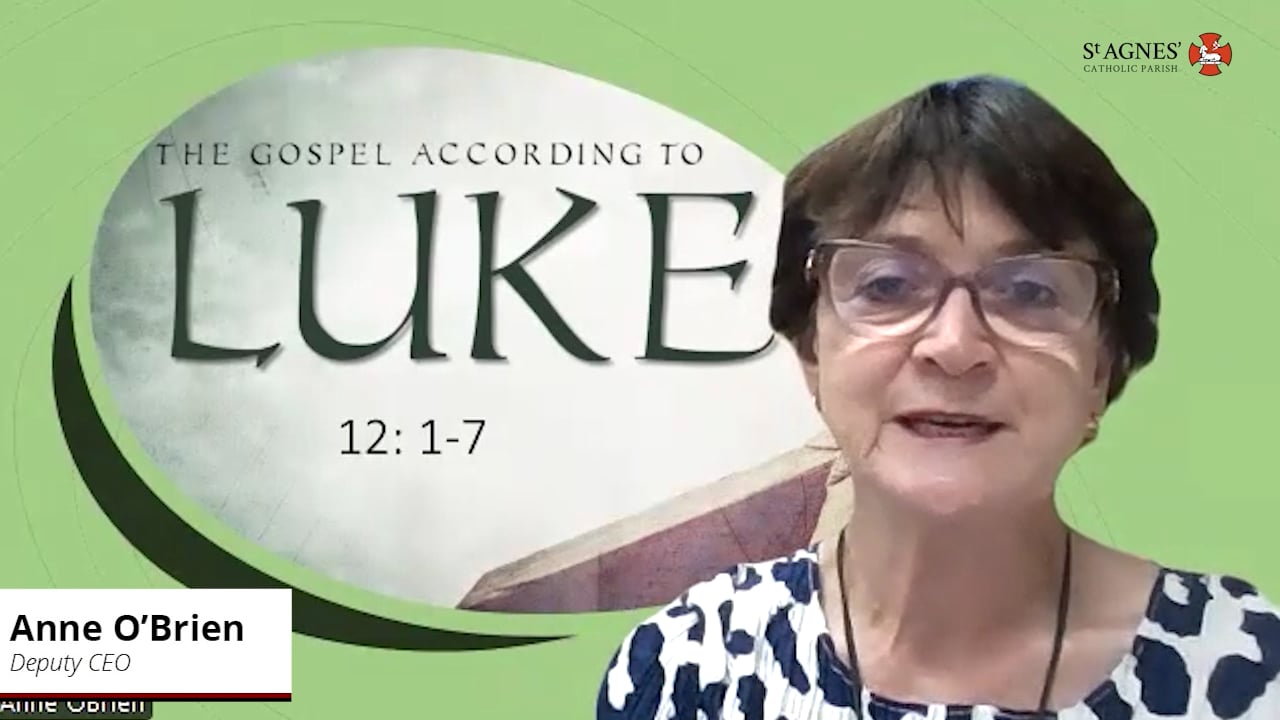
Gospel reflection – Friday in the 28th week of Ordinary Time - Warning and Encouragements
14 Oct 2026Anne O'Brien, Deputy CEO at St Agnes' Catholic Parish, today reads from the Gospel of Luke (12: 1-7), in which Jesus says "Be on your guard against the yeast of the Pharisees, which is hypocrisy."
Anne says, In this gospel Jesus used sparrows to show just how much God loves us. In his day there were so many sparrows , that they could be sold in the market for almost nothing. There’s little meat on these small birds but it didn’t matter. There were so many and they would increase and multiply for ever – or so it seemed. That’s why Jesus could say, that even if the smallest sparrow was known to God, there was, and is no such thing as an inconsequential person.
God doesn’t forget us, but it’s very easy for us to forget others, especially people who are vulnerable, or unpleasant, or whose habits drive others away. Yet these can be the very individuals who are crying out for recognition and love. They might be the sparrows we miss, but God remembers.
We may not always identify the people who are most in need of love. But we should take time to consider.
What about the person sitting next to me? Might something as simple as a smile and a greeting transform their day?
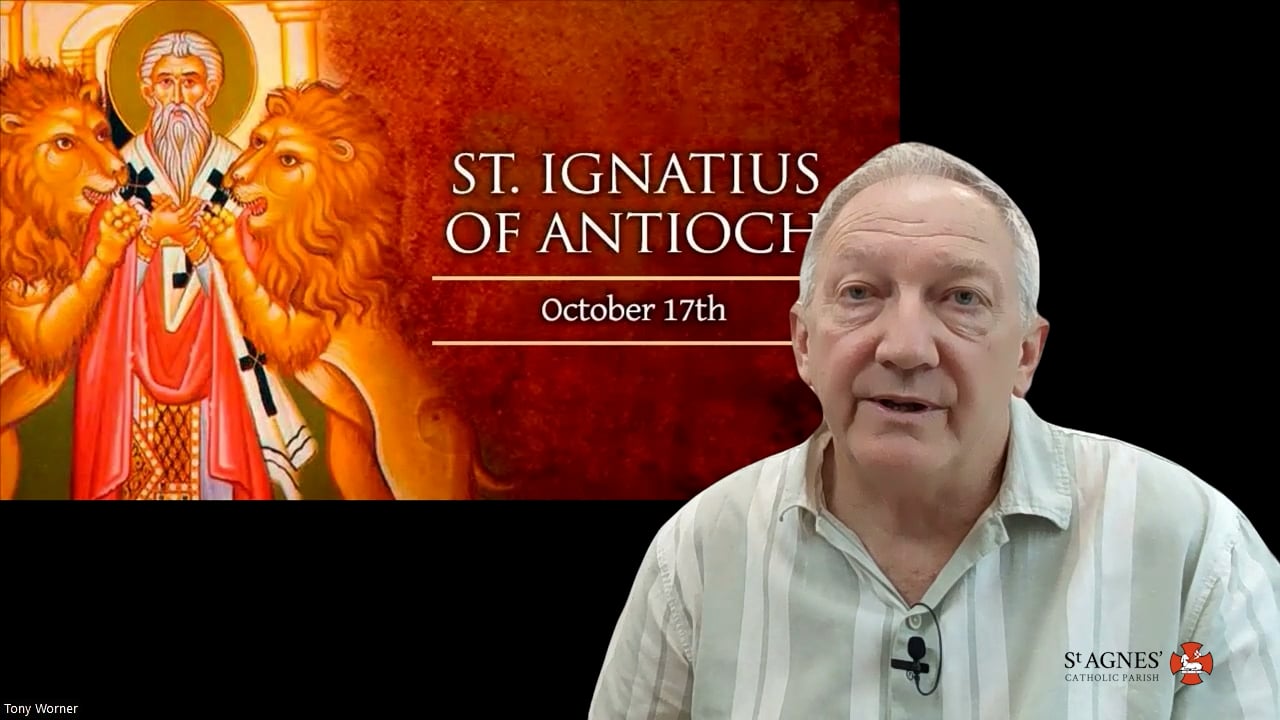
Gospel reflection – Saturday in the 28th week of Ordinary Time - St Ignatius of Antioch
14 Oct 2026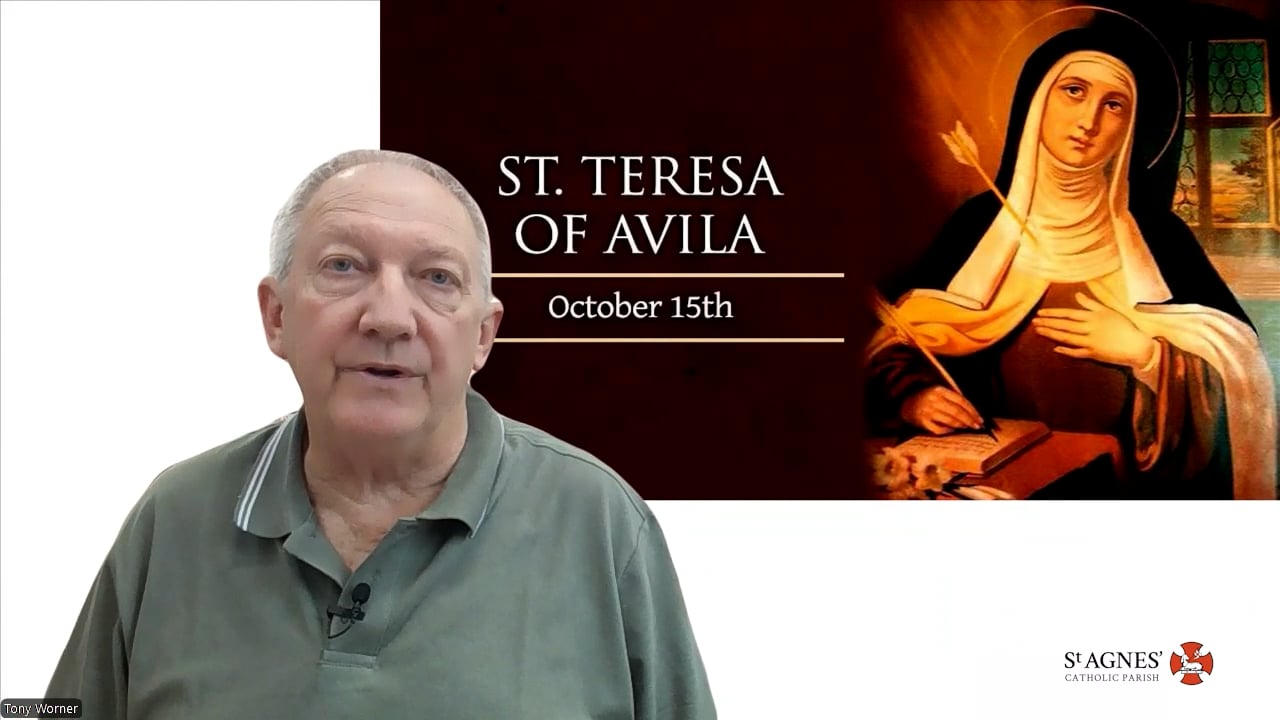
Gospel reflection – Thursday in the 28th week of Ordinary Time - St Teresa of Avila
14 Oct 2026Tony Worner, leader of formation at St Agnes' Catholic Parish, today reads from the Gospel of John (15: 1-8), in which Jesus says "I am the true vine, and my Father is the gardener."
Tony says, as mentioned, today we celebrate the Memorial of St Teresa of Jesus. Born at Avila, in Spain, Teresa entered the Carmelites in 1535. This of course was the time of the Protestant Reformation a time of political, social, and religious upheaval. In the Carmelites, at first, she lived a mediocre religious life but experienced a profound conversion in 1554. In collaboration with St John of the Cross, she undertook a reform of the Carmelites. Along the way she experienced profound mystical revelations along with many difficulties. Teresa composed works of the highest doctrines and mystical theology. She died at age 67 and was named a Doctor of the Church in 1970, one of only 4 women out of 38 who have been declared a doctor of the Church. She was the first with St Catherine of Siena.
The Gospel we have just heard was chosen for Teresa’s memorial because her life involved deep trials, internal dark nights, reform of the Carmelite Order, and facing opposition (including the Inquisition), mirroring the transformative and often painful "pruning" of the spiritual journey.
The gift of God to Teresa in and through which she became holy and left her mark on the Church and the world is threefold: She was a woman; she was a contemplative; and she was an active reformer.
St Teresa … pray for us.
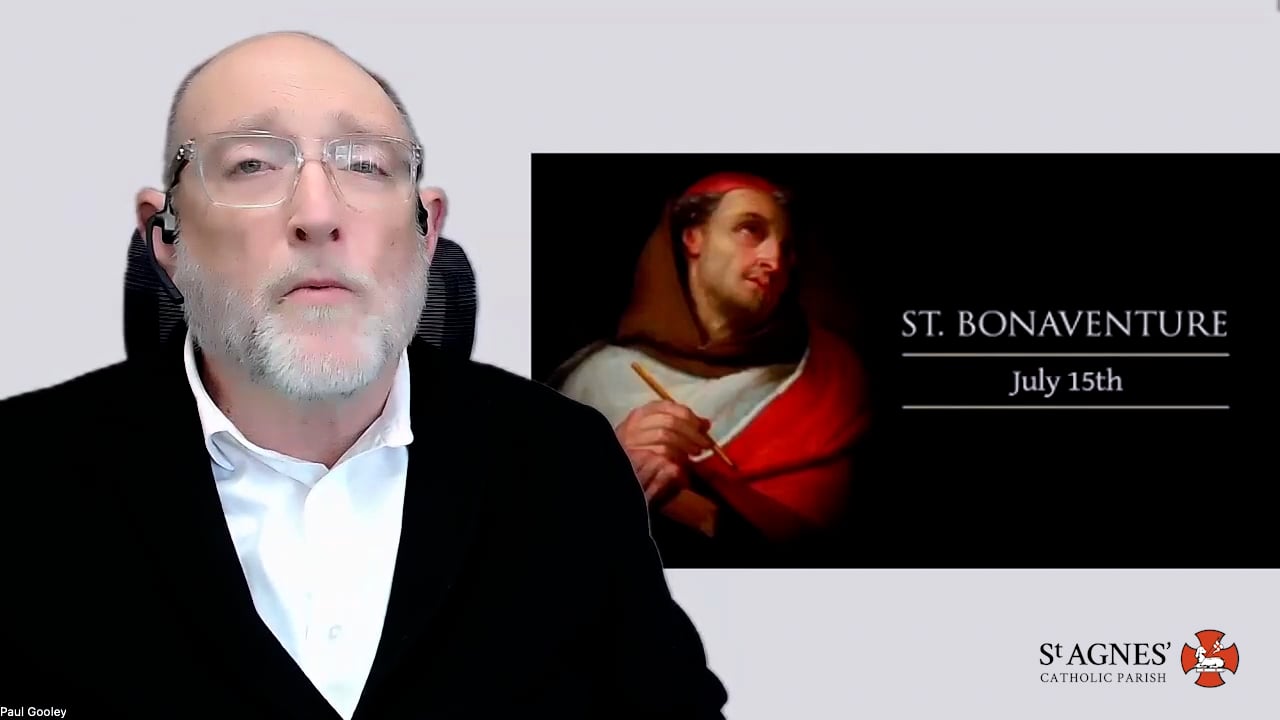
Gospel reflection – Wednesday in the 15th week of Ordinary Time - St Bonaventure
14 Jul 2026Today Fr Paul reads from the Gospel of Matthew (23: 8 – 12) in which Jesus says ‘But you are not to be called ‘Rabbi,’ for you have one Teacher, and you are all brothers.’ Afterwards Fr Paul shares about St Bonaventure whose memorial we celebrate today.
Fr Paul says Bonaventure was born in Etruria in about 1218. He became a Franciscan in 1243 and studied philosophy and theology at the University of Paris. He became a famous teacher and philosopher. He was a friend and colleague of St Thomas Aquinas.
At this time the friars were still a new and revolutionary force in the Church, and their radical embracing of poverty and rejection of institutional structures raised suspicion and opposition from many quarters. Bonaventure defended the Franciscan Order and, after he was elected general of the order in 1255, he ruled it with wisdom and prudence. He is regarded as the second founder of the Order.
He declined the archbishopric of York in 1265 but was made cardinal bishop of Albano in 1273, dying a year later in 1274 at the Council of Lyons, at which the Greek and Latin churches were (briefly) reconciled.
Bonaventure wrote extensively on philosophy and theology, making a permanent mark on intellectual history; but he always insisted that the simple and uneducated could have a clearer knowledge of God than the wise.
He was declared a Doctor of the Church in 1588.
In closing Fr Paul asks, St. Bonaventure…pray for us
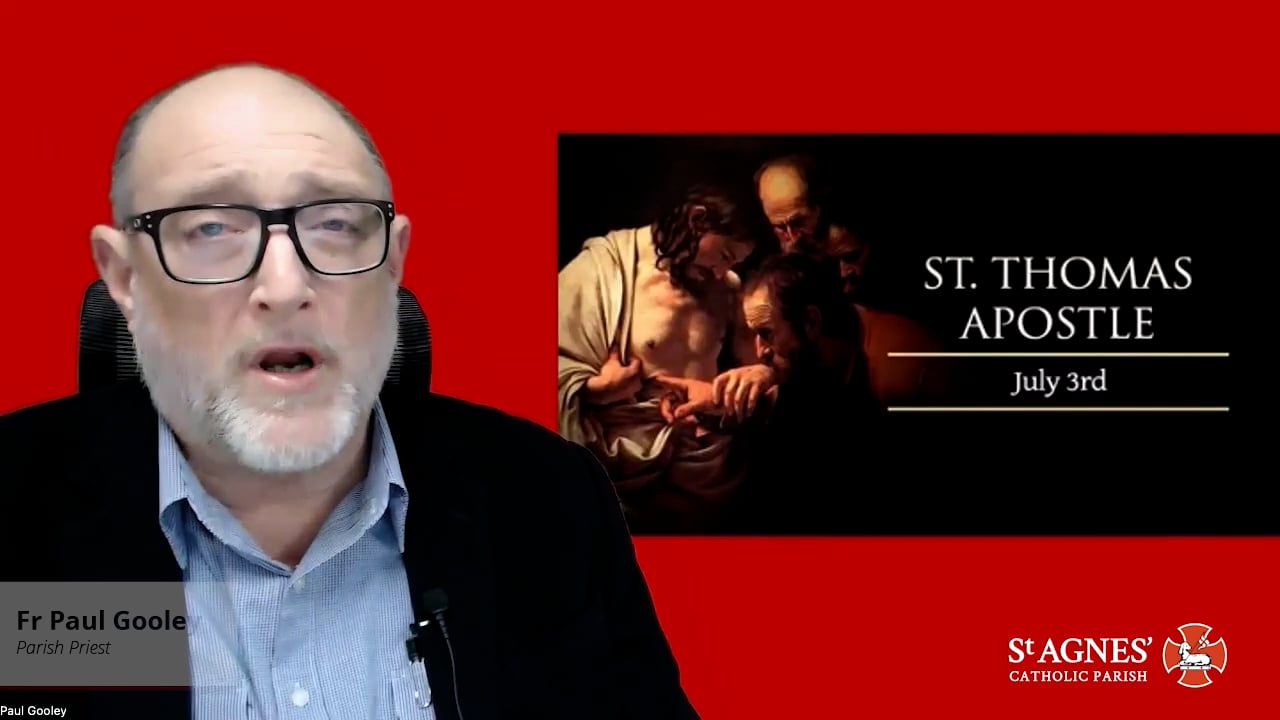
Gospel Reflection 13th Week in Ordinary Time - St Thomas, Apostle - 3 July
29 Jun 2026As we celebrate the feast of St Thomas, Fr Paul Gooley reads from the Gospel of John (20: 24-29) in which Jesus says to Thomas, who refused to believe that Jesus had risen unless he saw for himself, ‘You believe because you can see me; happy are those who have not seen and yet have believe’. Afterwards, Fr Paul shares a little about St Thomas, the apostle, whose life we celebrate today.
Fr Paul says the apostle Thomas is famous for doubting the resurrection of Jesus when his fellow apostles told him all about it; but if he is the sceptical apostle, he is also the believing apostle, for having seen and touched a risen man, he made the immediate leap of faith and so he became the first apostle to call Jesus, God.
Nothing is known about Thomas’s later life. A well-known apocryphal document called the Acts of Thomas relates his missionary journeys to Persia and India. Although the document as it stands is not historical evidence, it still bears witness to the likelihood of a tradition that Thomas did go to India.
We will probably never know for certain; but the Christians of Kerala in India have called themselves for centuries “St Thomas Christians”, and they may very well be right.
So, on this special day, Fr Paul invites us to ask, ‘St Thomas…pray for us!’
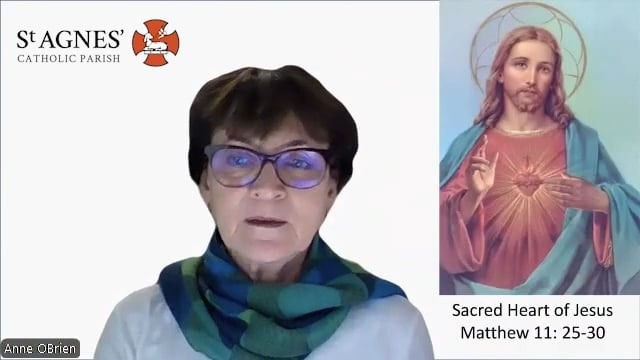
Gospel Reflection - Friday in the 10th week of Ordinary time - Sacred Heart of Jesus
11 Jun 2026Anne O’Brien reads from the Gospel of Matthew (11: 25 - 30At that time Jesus said, “I praise you, Father, Lord of heaven and earth, because you have hidden these things from the wise and learned, and revealed them to little children. Yes, Father, for this is what you were pleased to do. Afterwards, Anne shares more about the Feast of the Sacred Heart of Jesus.
Today, as we celebrate the Feast of the Sacred Heart of Jesus, we are invited to pause and reflect on one of the most beautiful and central images of our faith—the heart of Jesus.
The Sacred Heart is not simply a symbol of a physical heart. It is a way of speaking about who Jesus is at the very core of his being. It represents his love, his compassion, his mercy, and his complete self-gift to humanity. It is a heart that is open, wounded, and yet overflowing with love.
The Sacred Heart of Jesus reminds us that God’s love is deeply personal. We are not unknown or overlooked. Each of us is known by name, held in love, and valued beyond measure. There is no part of our lives—no struggle, no worry, no hidden burden—that is outside the reach of Christ’s compassion.
At times in life, we can feel distant from God, or even from one another. We may carry worries that others do not see, or feel pressure, exhaustion, or uncertainty. The Feast of the Sacred Heart reminds us that we are not alone in any of this. The heart of Jesus is close to the places in our lives where we most need hope.
But this feast is not only about receiving love—it is also about responding to it. We are invited to allow the heart of Christ to shape our own hearts. A heart that is more patient with others. A heart that forgives more easily. A heart that notices those who are left out or struggling. A heart that chooses compassion over judgement.
In our workplaces, schools, families, and communities, we are each given opportunities to reflect something of the Sacred Heart in how we speak, how we listen, and how we care for one another. Even small acts of kindness can become expressions of that same love.
So today we might ask ourselves: where do I need to experience more deeply the love and mercy of Christ? And where am I being invited to let my own heart become more like his?
Let us remember that the Sacred Heart of Jesus is not distant from us—it is present, active, and still reaching out in love today.
We end with a simple prayer:
Sacred Heart of Jesus,
teach us to trust in your love.
Help us to know your mercy more deeply,
and shape our hearts to be more like yours—
gentle, faithful, and full of compassion.
Amen.
Sign of the cross……In the name of the father , the son, and holy spirit . Amen
Gospel Reflection - Friday, the 9th Week in Ordinary Time (5 June)
4 Jun 2026Feast of St Boniface
Today Anne O’Brien shares the Gospel from the liturgy for the Feast of St Boniface (675-754AD) who was a bishop remembered for major reforms in the church in Germany and for his fidelity to the Pope of the time.
In this Gospel from John (10: 11-16) Jesus tells us he is the Good Shepherd - looking after us in much the same way as the shepherds of his time, who tended their flocks day and night, gathering the sheep into the sheepfold at night for the protection from the weather, thieves and predatory animals.
Anne reflects on the difference between a hired keeper and the shepherd who owns the flock. In the face of danger, the hired hand flees, whereas, the Good Shepherd who owns the flock shields them and would, if necessary, lay down his life for them.
Jesus is the loving protector and caretaker of his flock, ready to save them from destruction. He came as the one, the only one, who was (and is) completely committed to his flock, even to his own death and resurrection.
You may be wondering, why Jesus needed to give his life for our protection?
We have all sinned and by our sin, we are lost to the eternal life God has for us. We will not enter heaven if we don’t accept Jesus, the Good Shepherd, whose blood was shed for our sins and who lives as our Good Shepherd today through his resurrection.
If the Lord is our shepherd that makes us the sheep. Sheep are prone to wander and when we do, we should know that he is there to help us. In the scriptures, we learn so much about his compassion and gentleness and how he looks out for those who get lost along the way.
In conclusion, Anne invites us to prayer with Psalm 23:
The Lord is my shepherd; I shall not want. He maketh me to lie down in green pastures: he leadeth me beside the still waters. He restoreth my soul: he leadeth me in the paths of righteousness for his name's sake. Yea, though I walk through the valley of the shadow of death, I will fear no evil: for thou art with me; thy rod and thy staff they comfort me. Thou preparest a table before me in the presence of mine enemies: thou anointest my head with oil; my cup runneth over. Surely goodness and mercy shall follow me all the days of my life: and I will dwell in the house of the Lord for ever.
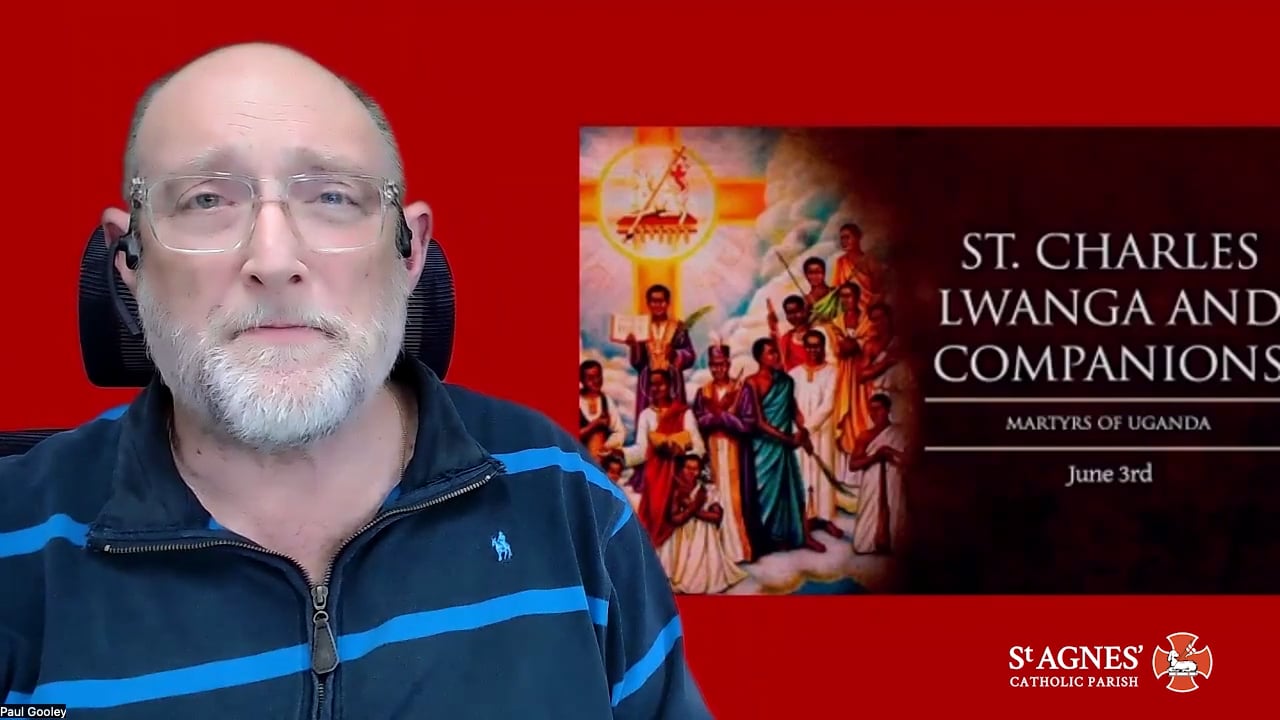
Gospel reflection – Wednesday in the 9th week - St Charles Lwanga and Companions
2 Jun 2026Fr Paul Gooley reads from the Gospel of Matthew (5: 1 - 12) in when Jesus saw the crowds, he went up on a mountainside and sat down. His disciples came to him, and he began to teach them. Afterwards, Fr Paul shares a bit about St Charles Lwanga and Companions who’s feast day we celebrate today.
Fr Paul says, Many Christians, Catholic and Protestant, were killed by the Ugandan king Mwanga. Some of them were servants in the king’s palace or even his personal attendants. Charles Lwanga and his twenty-one companions (the youngest, Kizito, was only 13) were executed for being Christians, for rebuking the king for his debauchery and his murder of an Anglican missionary.
They died between 1885 and 1887. Most of them were burned alive in a group after being tortured.
Within a year of their deaths, the number of catechumens in the country quadrupled. St Charles Lwanga is the patron of Catholic Action and of black African youth, and the Ugandan martyrs’ feast day is a public holiday in Uganda.
In closing, Fr Paul asks, St Charles Lwanaga… Pray for us.
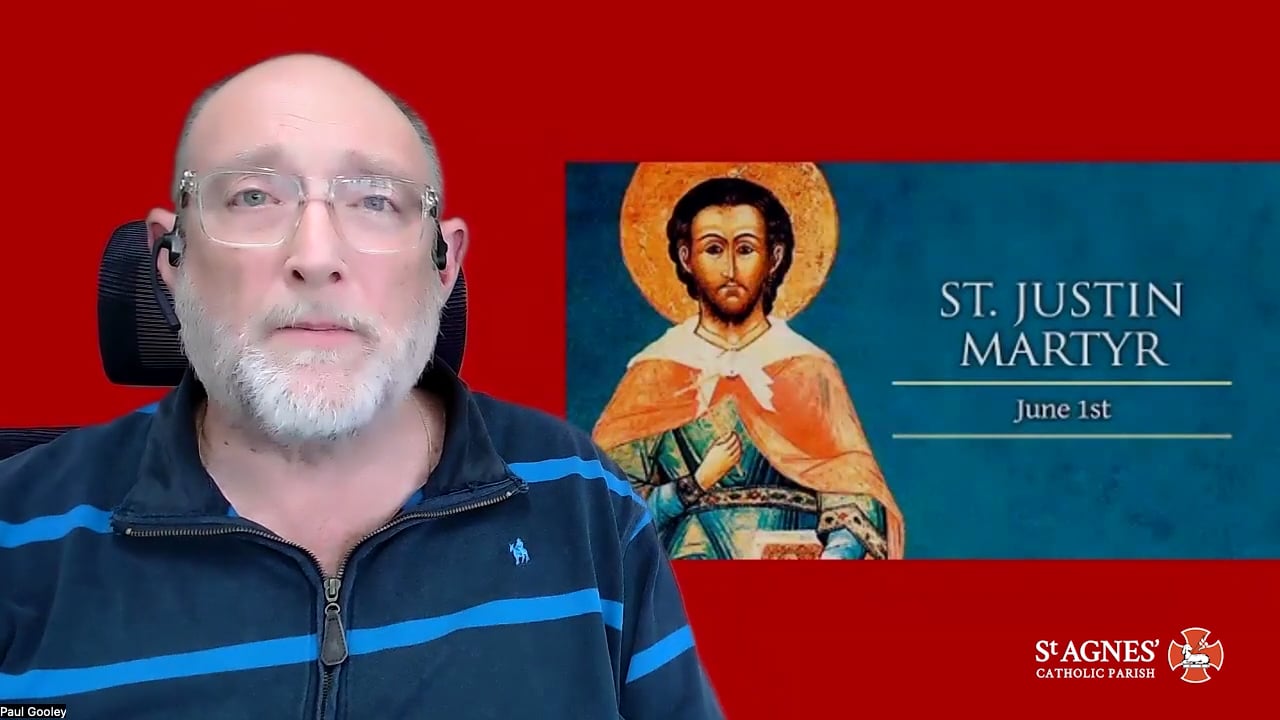
Gospel reflection – Monday in the 9th week - St Justin
1 Jun 2026Fr Paul Gooley reads from the Gospel of Matthew (5: 13 - 19) in which Jesus says to his disciples “You are the salt of the earth. But if the salt loses its saltiness, how can it be made salty again? It is no longer good for anything, except to be thrown out and trampled underfoot.” Afterwards, Fr Paul shares a bit about St Justin who’s feast day we celebrate today.
Fr Paul says, Justin was born at the beginning of the second century in Nablus, in Samaria, of a pagan Greek family. He was an earnest seeker of the truth and studied many systems of philosophy before being led to Christianity.
While remaining a layman, he accepted the duty of making the truth known and travelled from place to place proclaiming the gospel. In 151 he travelled from Ephesus to Rome, where he opened a school of philosophy and wrote defences and expositions of Christianity, which have survived to this day and are the earliest known writings of their kind. In the persecution of 165, in the reign of the emperor Marcus Aurelius, he was denounced as a Christian, arrested and beheaded. The transcript of his trial by the prefect of Rome, Rusticus, has also survived.
In closing, Fr Paul asks, St Justin… Pray for us.
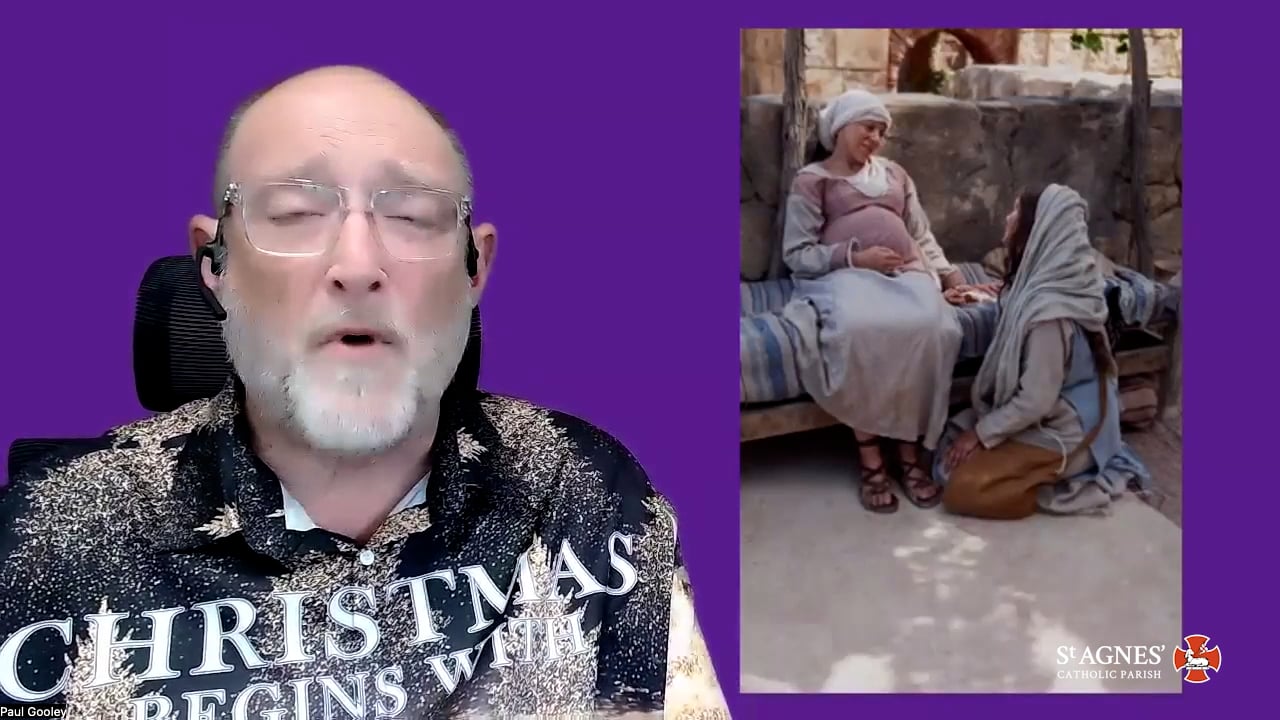
Gospel reflection - Mary’s Magnificat
15 Dec 2025Fr Paul Gooley reads from the Gospel of Luke (1: 46-56) in which Mary gives praise to God saying, “My soul glorifies the Lord and my spirit rejoices in God my Savior”.
Fr Paul says Mary’s Magnificat, as it is known, sums up the themes of the gospel.
On the one hand it is full of gratitude and praise to the God of mercy. This had been revealed on Sinai as the meaning of the sacred name of God when God passed before Moses crying, ‘The Lord, the Lord, God of mercy and compassion, rich in kindness and faithfulness’ (Exodus 34.6), a name which echoes countless times through the scriptures. And yet at the same time the song is full of tender reverence for the holiness of God, taking its tone also from Isaiah’s vision of the Lord in the Temple, when the Temple is filled with his glory and Isaiah can feel only his own unworthiness (Isaiah 6). God is so close and yet so distant.
On the other hand, Mary’s song is suggestive of God’s special love for the hungry and the powerless. This is apparent in all the Gospels, but especially in Luke, who is writing to remind a richer audience of their obligations. He stresses the poverty of the surroundings of Jesus’ birth, of the shepherds who first come to reverence him, the baby’s own refugee status.
His beatitudes focus not (as in Matthew’s) on Christian attitudes and motivations, but on the grinding poverty of those who don’t know where their next meal is coming from. He remains constantly aware of the dangers of wealth (parables of the Rich Fool, or the Rich Man and Lazarus) and the reversal of standards in God’s evaluations.
Finally, Luke carefully reminds us that the those who receive the message in these Infancy Stories, are the faithful in Israel, according to his mercy ‘to Abraham and his descendants for ever.’
The Almighty has done great things for Mary, as Christmas approaches, Fr Paul invites us to remember that the Almighty has done great things for us by sending his only son.
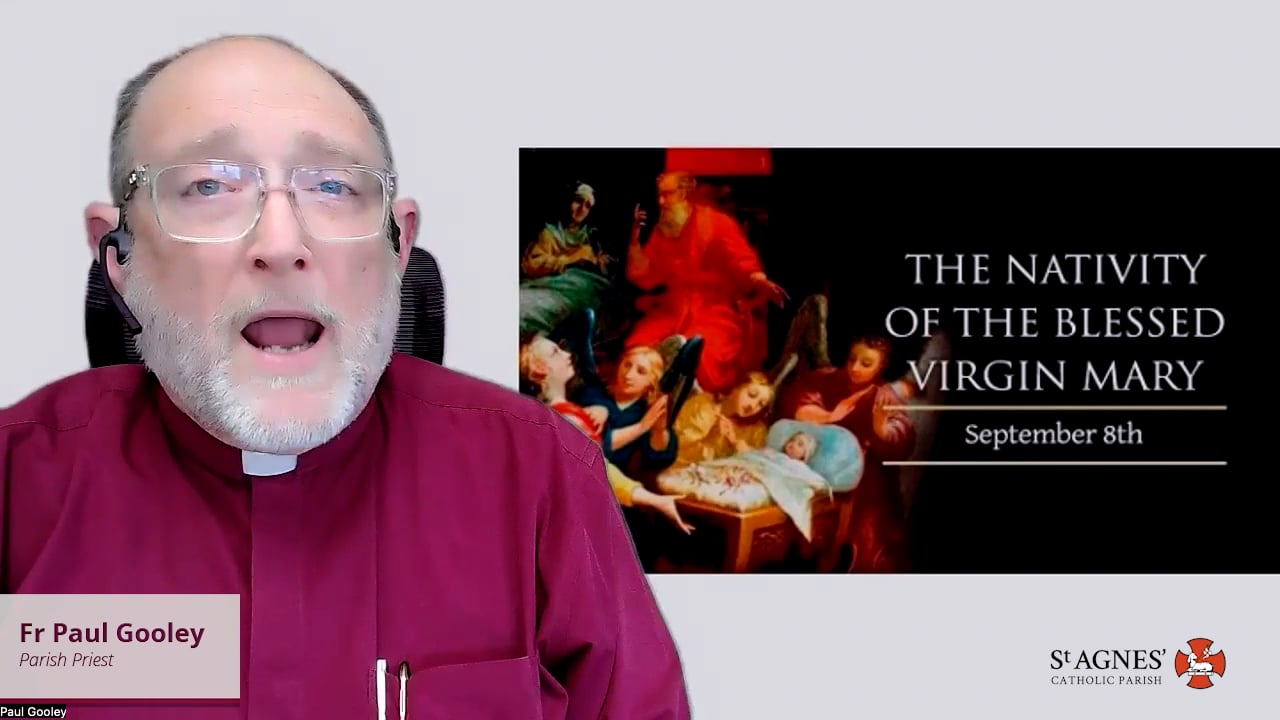
Gospel Reflection – The Nativity of the Blessed Virgin Mary - 8 September
8 Sep 2025As we celebrate the Feast of the Nativity of the Blessed Virgin Mary, Fr Paul reads from the Gospel of Matthew (1: 18-23) in which an angel of the Lord appears to Joseph in a dream and tells him ‘Do not be afraid to take Mary home as your wife, because what is conceived in her is from the Holy Spirit’.
Fr Paul says the Scriptures do not give us an account of Mary’s birth. But this is one of the three birthdays celebrated in our Liturgical Year:
· The birth of Jesus on December 25
· The birth of St John the Baptist on June 24
· and the birth of the Blessed Virgin Mary on September 8.
The feast on this date has been celebrated since before the sixth century, with origins from Syria and Palestine. The Church then spread this feast throughout Europe, with it becoming one of the major feasts of Mary celebrated throughout the universal church by the twelfth century. In fact, September 8 was a holy day of obligation up until 1918.
Fr Paul says like many other feasts that we celebrate for Mary…. today we simply honour Our Lady because we are celebrating her birth.
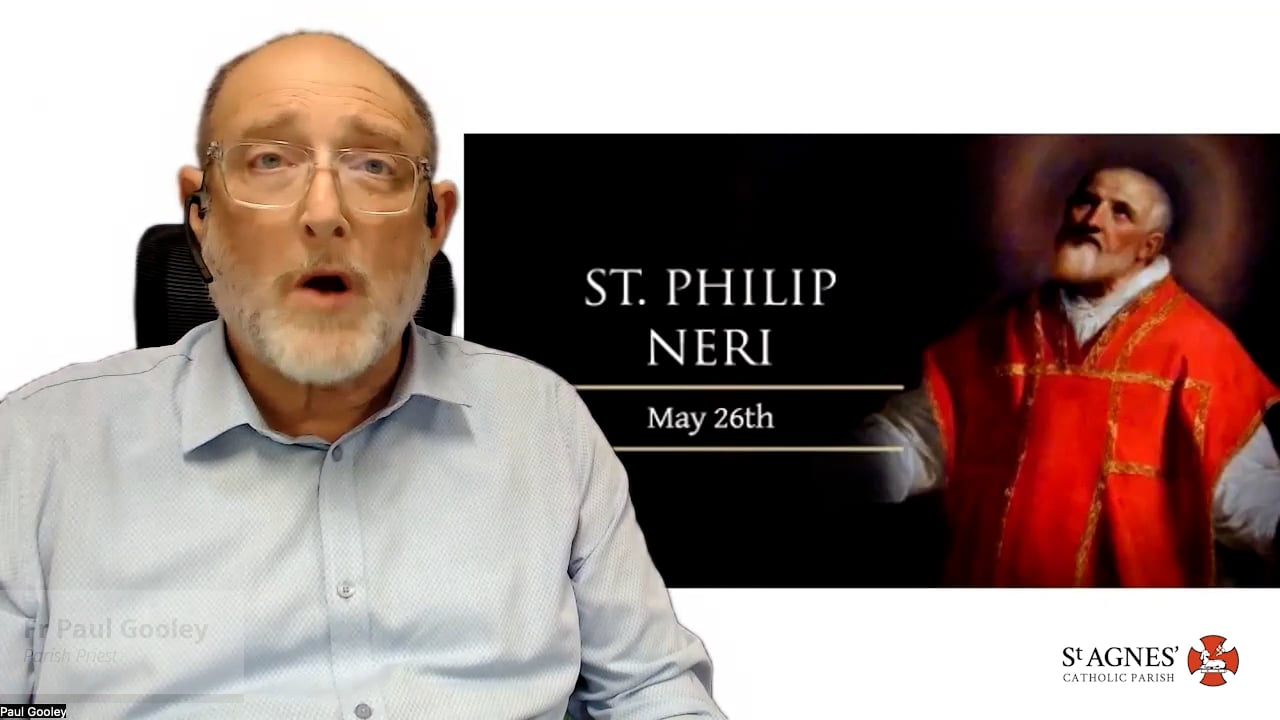
Gospel Reflection – 26 May - St Philip Neri
16 May 2025Fr Paul Gooley reads from the Gospel of John (17: 20-26) in which Jesus prays to his Father, ‘May they be one in us as you are in me, and I am in you’.
Fr Paul says St Philip, whose life we celebrated today, was born in Florence in 1515. At the age of eighteen he went to Rome and earned his living as a tutor. He undertook much-needed charitable work among the young men of the city and started a brotherhood to help the sick, poor and pilgrims.
He was advised that he could do more good as a priest, and was ordained in 1551. He built an oratory where he invented services, consisting of spiritual readings and hymns, which were the origin of the oratorio (tradition is a good thing; but innovation also has its place). He continued to serve the young men of Rome, rich and poor alike, with religious discussions and by organising charitable enterprises. He had a particular care for the young students at the English College in Rome, studying for a missionary life and probable martyrdom in England.
He inspired other clergy to emulate him and formed them into the Congregation of the Oratory. Oratorian foundations still flourish in many countries today. Philip died in Rome in 1595.
St Philip Neri was an enemy of solemnity and conventionality. When some of his more pompous penitents made their confession to him (he was famous as a confessor) he imposed salutary and deflating penances on them, such as walking through the streets of Rome carrying his cat (he was very fond of cats). When a novice showed signs of excessive seriousness, Philip stood on his head in front of him, to make him laugh. When people looked up to him too much, Philip did something ridiculous so that they should not respect someone who was no wiser – and no less sinful – than they were. In every case there was an excellent point to his pranks: to combat pride, or melancholy, or hero-worship.
Laughter is not much heard in churches: perhaps that is to be expected... but outside church, Christians should laugh more than anyone else – laugh from sheer joy, that God bothered to make us, and that he continues to love us despite the idiots we are. Everyone is a sinner, but Christians are sinners redeemed – an undeserved rescue that we make even less deserved by everything we do. It is too serious a matter to be serious about: all we can reasonably do is rejoice.
Very many of the saints, not just St Philip, have an abiding terror of being looked up to. For they know their imperfections better than anyone else and being revered by other people is doubly bad. It is bad for the others, who should be revering God instead, and for themselves, because they might be tempted to believe their own image and believe themselves to be worthy.
We are not saints yet, but we, too, should beware. Uprightness and virtue do have their rewards, in self-respect and in respect from others, and it is easy to find ourselves aiming for the result rather than the cause. Let us aim for joy, more than respectability. Let us make fools of ourselves from time to time, and thus see ourselves, for a moment, as the all-wise God sees us
.
Today, Fr Paul invites us to ask ‘St Philip Neri, pray for us!’
Gospel Reflection – Our Lady Help of Christians
16 May 2025On the feast of Our Lady Help of Christians Fr Paul Gooley reads from the Gospel of John (19: 25-27) in which Jesus saw his mother at the foot of the cross and the disciple whom he loved standing nearby. He said to her, “Woman, here is your son,” and to the disciple, “This is your mother.”
Fr Paul says under the title of Help of Christians, Mary was chosen as Patroness of Australasia by the First Provincial Synod, convened by Archbishop Bede Polding, in Sydney in 1844. The fledgling colonies needed Mary’s help at that time, as the nation still does today.
We are helped through Mary’s powerful intercession, and through the example of her life that we find in the Gospels.
Today, Fr Paul invites to ask, ‘Our Lady, Help of Christians…Pray for us!’
Gospel Reflection – Monday 5th Week of Easter - The one who loves me
15 May 2025Fr Paul reads from the Gospel of John (14: 21-26) in which Jesus says, “The one who loves me will be loved by my Father, and I too will love them and show myself to them”.
This reading begins to teach what love means: to love Jesus means to keep his commandments. This is not a matter of mere obedience but of loving imitation. If I love a person I want to keep that person’s commandments, both out of loyalty and out of respect for that person’s qualities: the commandments will reveal and mirror that person’s qualities. So, the Law given by Moses reveals God’s nature by what he commands. In the same way the actions of Jesus reveal his and the Father’s nature: Jesus heals, he loves, he judges, he forgives, he commands. To obey the commands is a response in love: we need to do just that.
We have also for the first time one of the four sayings on the Paraclete – the Holy Spirit. ‘Paraclete’ is the Greek for the Latin-stemmed ‘Advocate’, who is ‘called to the side’ of someone in need.
The Paraclete is to represent Jesus, to carry on Jesus’ work, to act in the name of Jesus and to make Jesus present when Jesus is no longer there. We will learn gradually what this implies.
The first element is teaching, to complete and explain what Jesus has revealed, the implications of the Good News of Jesus. We see this in the Church, making present to every generation the implications of the Good News. The presence of the Paraclete makes it possible for frail and fallible human beings to mediate the work of Jesus.
Today’s Gospel Challenge – Let us show our love for Jesus by imitating him and let us ask the Holy Spirit to help us.
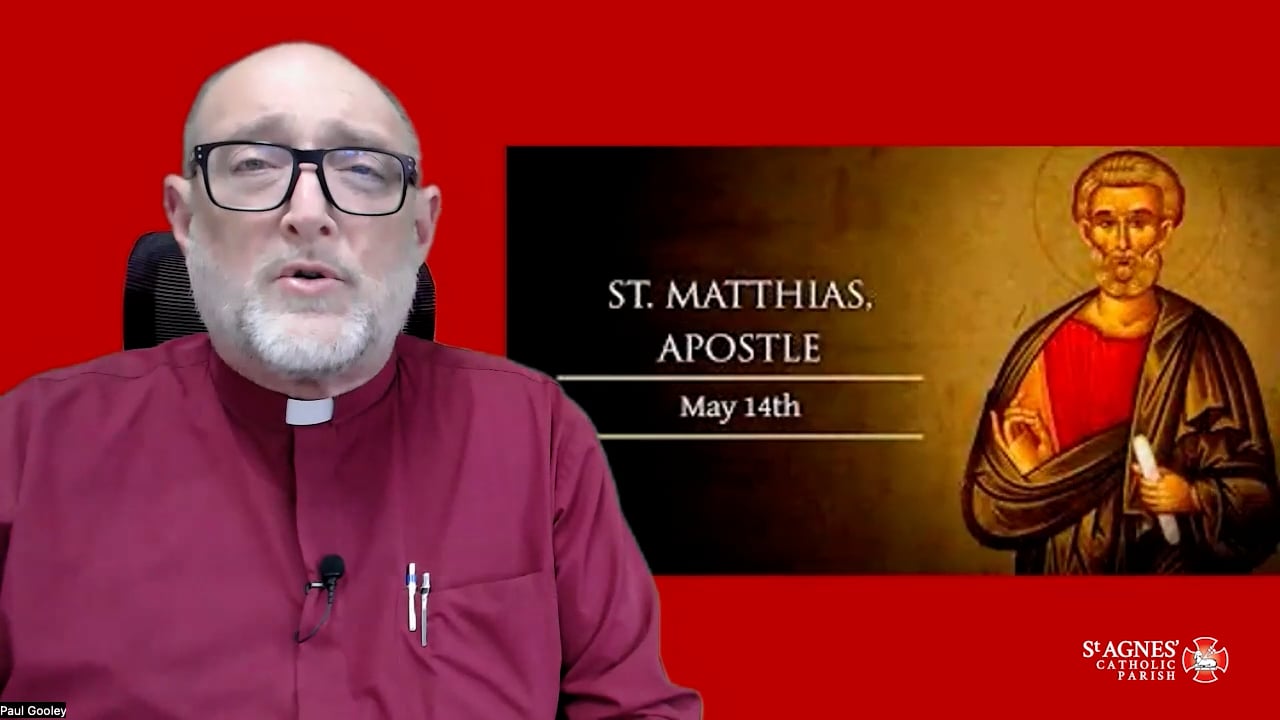
Gospel Reflection – St Matthias (14 May)
12 May 2025Fr Paul Gooley reads from the Gospel of John (15: 9-17) in which Jesus says ‘This is my commandment: Love one another as I have loved you. A person can have no greater love than to lay down one’s life for one’s friends.’ Afterwards, Fr Paul shares a little about St Matthias whose life we celebrate today.
Fr Paul says Matthias was not originally one of the Twelve; but after the treachery and death of Judas Iscariot, someone was needed to take Judas’s place. Two candidates were selected, and lots were drawn to see which of them should be made one of the Twelve: the choice fell on Matthias. Nothing much else is known about his subsequent history.
Drawing lots to select a candidate for an office sounds strange to us, but it was a recognised Jewish custom. For example, the priest who was to enter the Temple sanctuary and burn incense there was not chosen by a roster system but by lot. Random events, independent of any obvious natural or human cause, were seen as a direct expression of God’s will. Drawing lots was not a substitute for human decision – human beings had chosen Matthias as a candidate, human beings decided which priests were eligible on which days to enter the Temple – but the casting of lots was a way of putting the final choice into the hands of God.
In closing, Fr Paul says, as we do in the tradition of our Church, today we ask…’St Matthias, pray for us!’
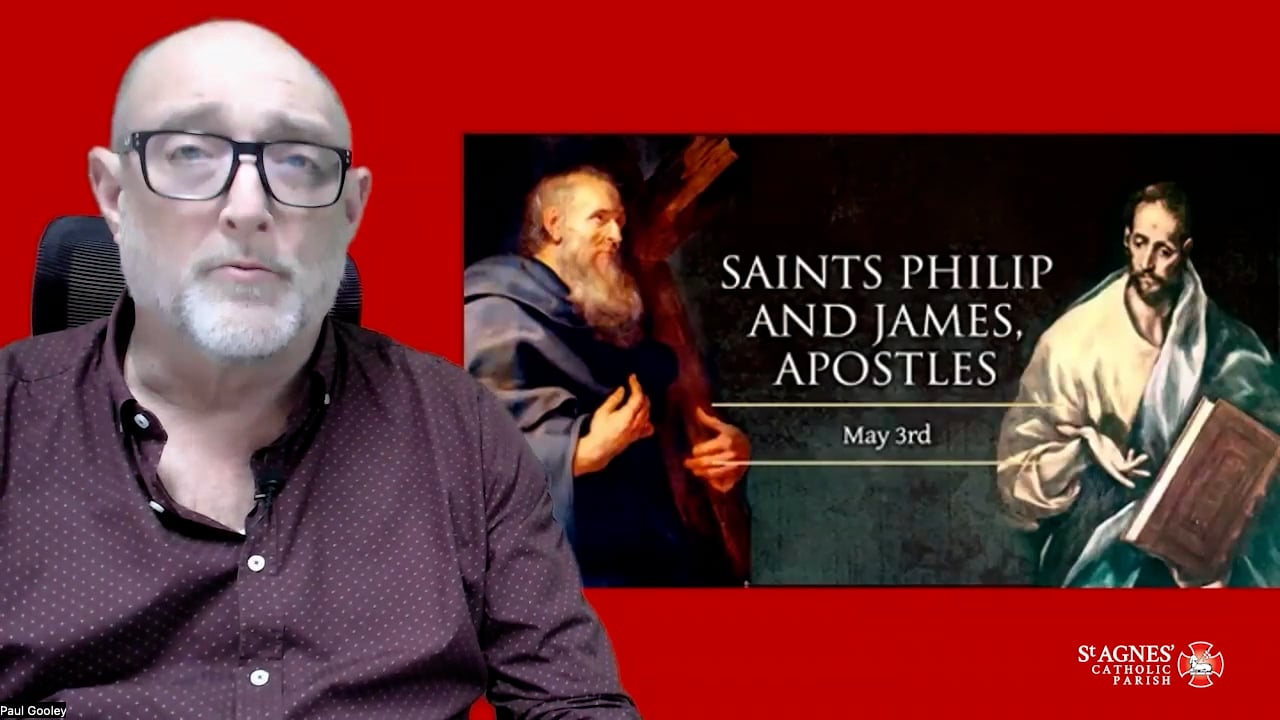
Gospel Reflection - 3 May - Saints Philip & James
30 Apr 2025Fr Paul Gooley reads from the Gospel of John (14: 6-14) in which Jesus says, “I am the way and the truth and the life. No one comes to the Father except through me. If you really know me, you will know my Father as well. From now on, you do know him and have seen him.” Afterwards, Fr Paul shares a little about Saints Philip and James whose memorials we celebrate today.
Fr Paul says Philip was born at Bethsaida and started as a disciple of John the Baptist. After John the Baptist’s death he then followed Christ.
James the son of Alphaeus is called ‘James the Less’, to distinguish him from James the son of Zebedee. James ‘the brother of the Lord’ ruled the Church at Jerusalem; wrote an epistle; led an austere life; and converted many Jews to the Faith. He was crowned with martyrdom in the year 62.
Jerome held these two Jameses to be the same person, and this was certainly the prevailing opinion when the feast of Philip and James was instituted in 560. Nowadays scholars prefer to divide them, in which case, we might think of today as being the feast of Philip and James and James.
So today, in the tradition of our Church, Fr Paul invites us to ask… St Philip & St James… pray for us!
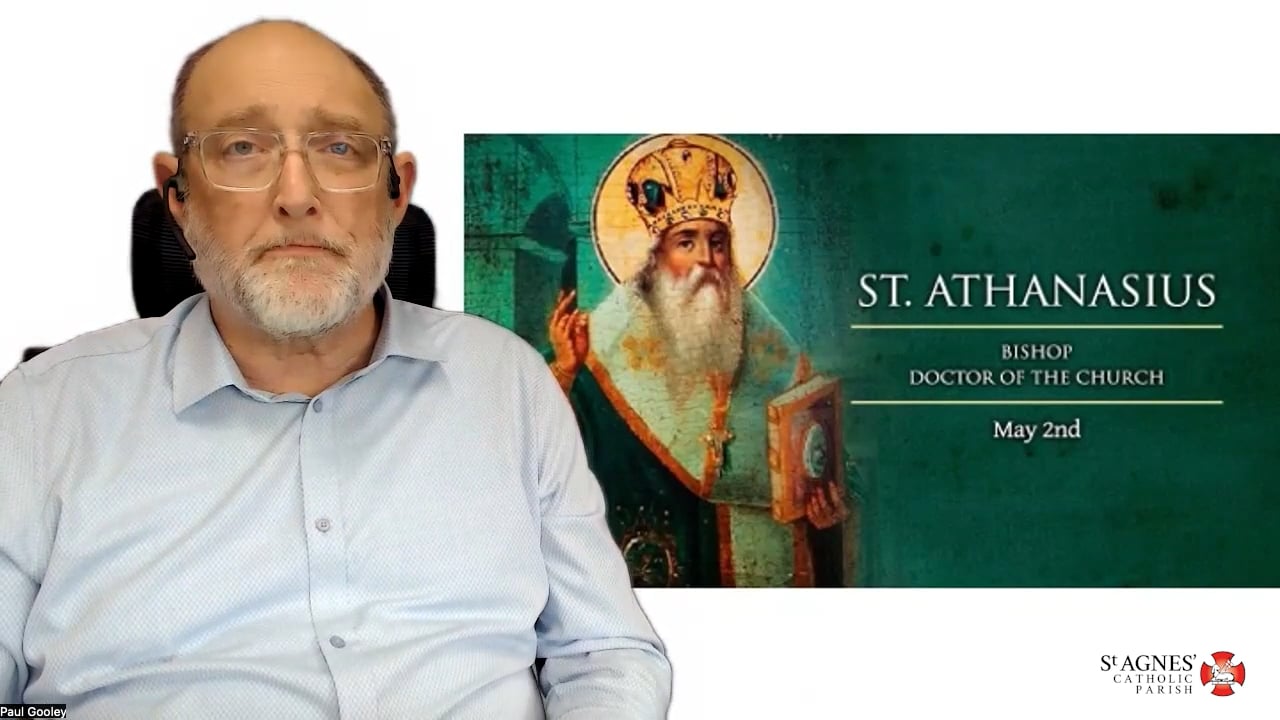
Gospel Reflection – 2 May - St Athanasius
30 Apr 2025Fr Paul Gooley reads from the Gospel of Matthew (10: 22-25) in which Jesus said to his disciples, ‘You will be hated by all men because of my name, but the one who stands firm to the end will be saved’. Afterwards, Fr Paul shares a little about the life of St Athanasius (Bishop and Doctor of the Church) whose memorial we celebrate today.
Fr Paul says Athanasius was born in Alexandria. He assisted Bishop Alexander at the Council of Nicaea and later succeeded him as bishop. He fought hard against Arianism all his life, undergoing many sufferings and spending a total of 17 years in exile. He wrote outstanding works to explain and defend orthodoxy.
So, today, Fr Paul invites us to ask, ‘St Athanasius… pray for us!’.
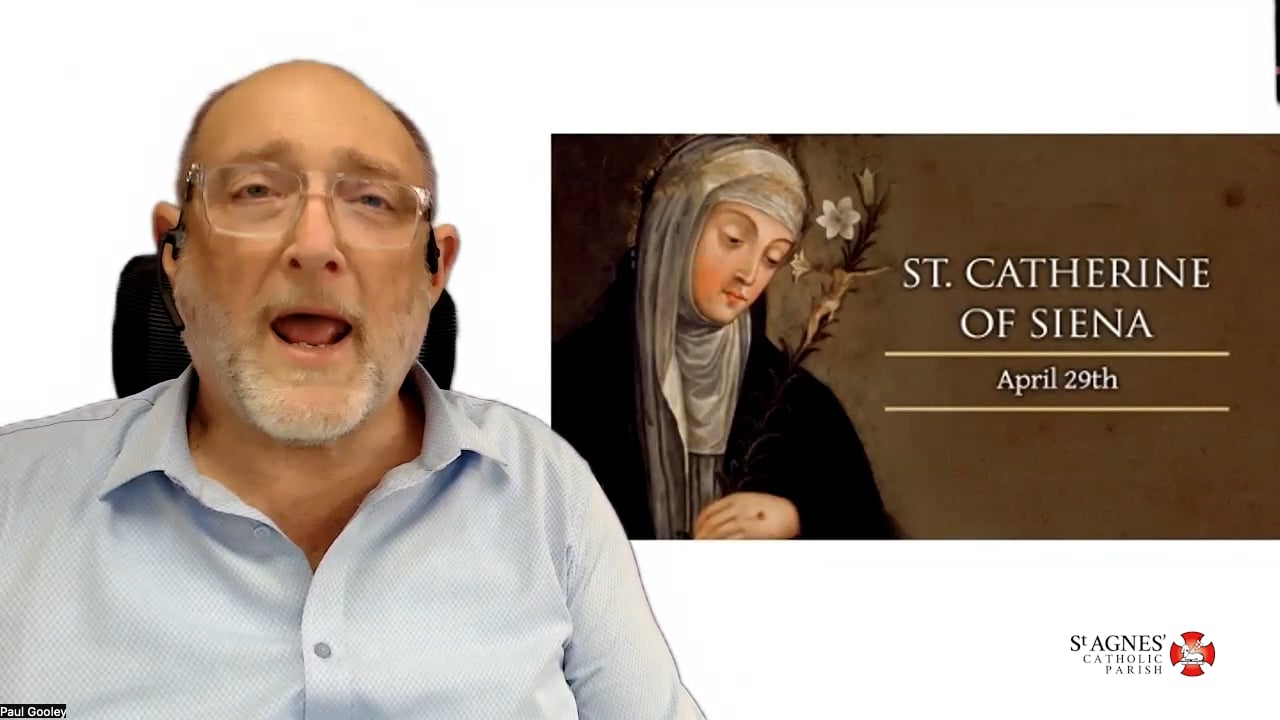
Gospel Reflection – 29 April - St Catherine of Siena
16 Apr 2025Fr Paul Gooley reads from the Gospel of Matthew (11: 25-30) in which Jesus says, ‘Come to me, all you who are labour and overburdened, and I will give you rest. Shoulder my yoke and learn from me, for I am gentle and humble in heart, and you will find rest for your souls. Yes, my yoke is easy and my burden light’. Afterwards, Fr Paul shares a little about the live of St Catherine of Siena, whose memorial we celebrate today.
Fr Paul says Catherine was born in Siena and, seeking perfection, entered the Third Order of the Dominicans when she was still in her teens.
In 1370 Catherine was commanded by a vision to leave her secluded life and enter the public life of the world. She wrote many letters to major public figures and carried on a long correspondence with Pope Gregory XI, urging him to reform the clergy and the administration of the Papal States. She burned with the love of God and her neighbour.
As an ambassador Catherine brought peace and harmony between cities. She fought hard to defend the liberty and rights of the Popes and did much for the renewal of religious life. She also dictated books full of sound doctrine and spiritual inspiration.
Catherine died on 29 April 1380. In 1970 Pope Paul VI declared her a Doctor of the Church.
So, today, Fr Paul invites us to ask, ‘St Catherine of Sienna…Pray for us!’
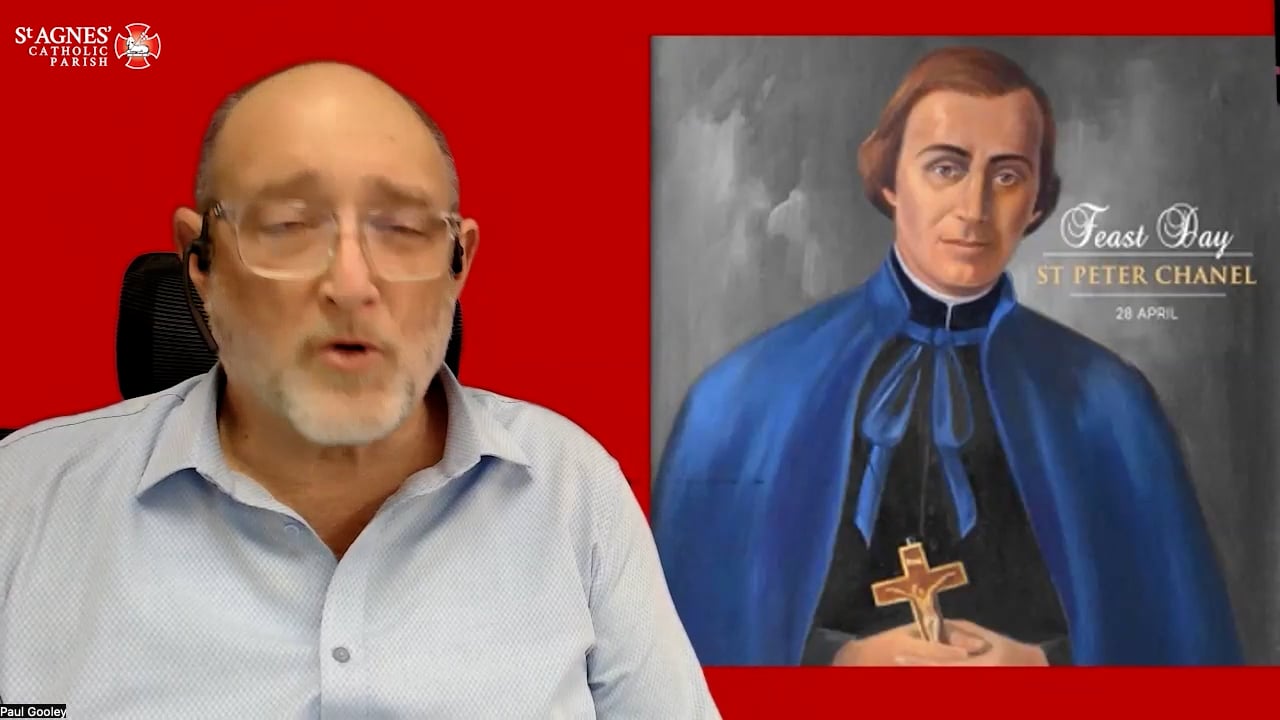
Gospel Reflection - 28 April - St Peter Chanel
16 Apr 2025Fr Paul reads from the Gospel of Mark (1: 14-20) In which Jesus, after John the Baptist was arrested, went into Galilee proclaiming the good news of God.
Fr Paul says Peter Chanel was born in France, at Cuet (near Belley), in 1803. He had been a priest for three years when he was accepted by the Marists who were a missionary order. He was sent out to evangelize the island of Futuna in the Pacific, where cannibalism had only recently been banned by the local ruler, Niuliki.
At first all went well, and Father Chanel and his lay assistants made many converts; but as he learned the local language and gained the confidence of the people, Niuliki became jealous and fearful; and the baptism of his son and his son’s friends was the last straw.
While Father Chanel’s companions were away, Niuliki sent men who set upon him and clubbed him to death. His mission had lasted only three years. He is listed as the first martyr of the South Seas.
Today, Fr Paul invites us to ask, ‘St Peter Chanel…Pray for us!’
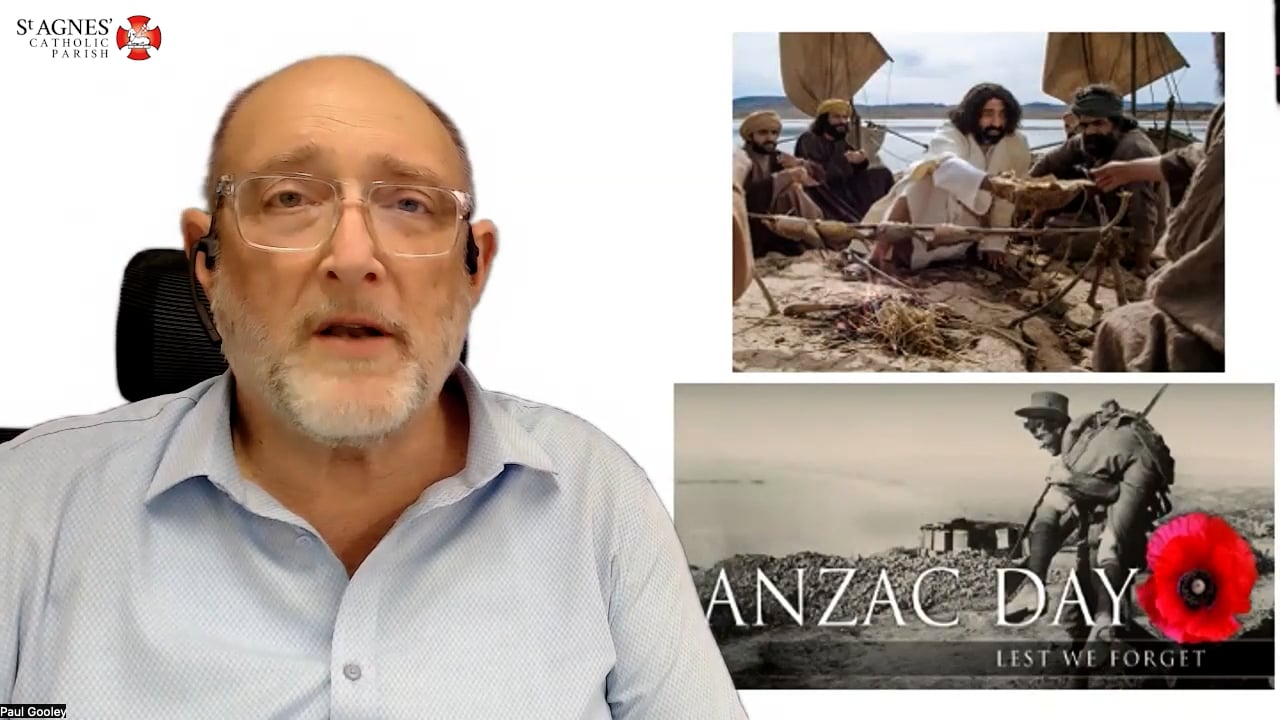
Gospel Reflection – Friday in Easter Octave - ANZAC Day
16 Apr 2025As we commemorate ANZAC day, Fr Paul Gooley reads from the Gospel of John (21: 1-14) which recounts the miraculous catch of fish.
Fr Paul says today’s Gospel passage offers us profound insights into faith, obedience, and the presence of the Risen Lord in our lives.
The disciples, after the death of Jesus, find themselves back in their familiar surroundings, fishing on the Sea of Tiberias. Simon Peter declares, 'I am going fishing’, and the others decide to join him. They fish all through the night, but they catch nothing. This fruitless night symbolizes the disciples' confusion and disappointment after the crucifixion. They were uncertain and perhaps felt a sense of hopelessness.
As dawn breaks, Jesus appears on the shore, though the disciples do not immediately recognise him. Jesus asks if they have caught anything and when the response is no, Jesus instructs them to cast their net on the right side of the boat, promising they will find some. Trusting in his word, they obey, and to their astonishment, they are unable to haul in the net because of the enormous quantity of fish. This miraculous catch demonstrates the power of obedience and faith in Jesus.
This passage teaches us that even when we feel lost or discouraged, Jesus is present in our lives. Like the disciples, we may sometimes return to our old ways, seeking comfort in the familiar when faced with uncertainty. However, Jesus calls us to trust in his guidance and to cast our nets where he directs us. When we obey his word, we can experience abundance beyond our expectations.
So let us, therefore, have faith in the lord, obey his teachings, and recognize him in our daily lives. Just as the disciples experienced the miraculous catch after trusting in Jesus, we too can find renewed hope and joy in his presence. May we always be open to his call, ready to cast our nets where he leads us, and willing to share in the communion he offers.
Fr Paul notes, today is also Anzac Day and as we remember the sacrifices of the Anzacs and reflect on the Gospel, let us renew our commitment to recognizing Christ in our lives. Let us honor the memory of those who have fallen by striving for peace and justice in our world and let us pray for the strength to follow Christ's example of love and service.
Praying for those who have died is, first and foremost, a sign of appreciation for the witness they have left us and the good that they have done. It is giving thanks to the Lord for having given them to us and for their love and their friendship.
Today, especially, Lest we forget.
Gospel Reflection – Easter Saturday - Proclaim the Good News
14 Apr 2025Today Fr Paul Gooley reads from the Gospel of Mark (16: 9-15) in which, Jesus, when he appears to the Eleven tells them, ‘Go out to the whole world and proclaim the Good News to all creation’.
Fr Paul says there is general agreement among scholars that the last few verses of Mark’s Gospel were not written by the same author as the rest of the Gospel, but were added later, and added was a summary of the appearances of the Risen Christ that were expressed in the other Gospels.
Because Mark’s Gospel was the first one written it ended with the account of the empty tomb and once the meetings with the Risen Christ had been described in the later Gospels it was felt that there was something missing from Mark’s Gospel and a supplement was needed.
The summary in today’s Gospel stresses that what had happened was utterly beyond the realm of human experience. Yes, it was utterly beyond anything which human nature could accomplish. And yet that is what the power and kindness of God accomplished, and these appearances of Jesus are cited to prove it.
In this Gospel and summary, we are warned that many would not believe, and the first two appearances of Jesus tell us of this disbelief. It is only the third time Jesus appears and commissions the apostles to go out and proclaim the good news that acceptance of what has happened finally occurs.
For our reflection and prayer today, Fr Paul invites us to consider – How do I go out and proclaim the Good News to those around me, here and now?
Gospel Reflection – Easter Thursday - Jesus reveals himself
14 Apr 2025Today Fr Paul Gooley reads from the Gospel of Luke (24: 35-48) in which Jesus comes among the disciples and says to them, “Peace be with you.”
Fr Paul says in the previous Gospel reading the two disciples had met Jesus on their way to Emmaus. There Jesus had used the Eucharistic meal to reveal himself to them, for the Eucharist is always an occasion for us to get to know the Risen Christ better.
Now he meets the whole group of disciples in their refuge, the Upper Room. The stress is on their meeting with a real person, not a ghost or phantom but a real person. This is why Jesus eats a piece of fish in front of them.
With this Gospel in mind, Fr Paul invites us to reflect that we, too, are called to be witnesses of the risen Christ just like the disciples were.Today Fr Paul Gooley reads from the Gospel of Luke (24: 35-48) in which Jesus comes among the disciples and says to them, “Peace be with you.”
Fr Paul says in the previous Gospel reading the two disciples had met Jesus on their way to Emmaus. There Jesus had used the Eucharistic meal to reveal himself to them, for the Eucharist is always an occasion for us to get to know the Risen Christ better.
Now he meets the whole group of disciples in their refuge, the Upper Room. The stress is on their meeting with a real person, not a ghost or phantom but a real person. This is why Jesus eats a piece of fish in front of them.
With this Gospel in mind, Fr Paul invites us to reflect that we, too, are called to be witnesses of the risen Christ just like the disciples were.
Gospel Reflection – Easter Wednesday - On the road with Jesus
14 Apr 2025Today Fr Paul Gooley reads from the Gospel of Luke (24: 13-35) in which two followers of Jesus were on the road to a village called Emmaus, as they walked along discussing all that had happened in Jerusalem, Jesus himself came up and walked along with them but they did not recognise him.
Fr Paul says this attractive and delicate story is a story of the journey to faith in the Risen Christ.
The two disciples start off deep in depression and disappointment. But they are open-minded and willing to learn as the Stranger explains to them from scripture the meaning of events. Their hearts burn within them at the Stranger’s words, but their eyes remain closed. It is only in the sacramental meal that they recognise the Risen Christ.
The Eucharist is a sacrament of initiation, bringing us to the intimate, personal encounter with Christ.
Once they have been enlightened and have learnt the profound meaning of the events, the truth of the scriptures and the resurrection, then the disciples return to the Holy City and carry on their own Christian apostolate by spreading the news of the resurrection.
Today’s Gospel Challenge, which Fr Paul invites us to reflect and pray on: This is what all of us are called to do – We are all called to understand and then pass on the meaning of Christ’s resurrection.
Gospel Reflection – Easter Tuesday (2 April) - An act of faith
14 Apr 2025Today Fr Paul Gooley reads from the Gospel of John (20: 11-18) in which Mary, weeping outside the tomb of Jesus, does not recognise him when she encounters him.
Fr Paul says, again, this is a scene of hesitation and partial recognition.
One wonders if this hesitation is stressed in order to emphasise how far beyond all human possibility was the Resurrection of Jesus, and also how firm the disciples were in their conviction that Jesus was dead?
This unwillingness to believe makes the disciples subsequent faith in the Resurrection all the more convincing. In this scene there is also the strong hint that the act of faith in the Resurrection, involves also love, the heart, as well as the intellect.
Whether this is Mary of Magdala who wept at Jesus’ feet or whether this is only a Christian interpretation, remains unclear. But the intimacy of the meeting shows that she is surely a figure of love. She was one of the few who not only followed Jesus as a supporter, but she also stuck it out to the end at the crucifixion and now the resurrection.
For our prayer today, Fr Paul asks us to think of all the things around us that people said was totally and utterly impossible and, yet now is possible.
Gospel Reflection – Easter Monday - Do not be afraid
14 Apr 2025Today Fr Paul Gooley reads from the Gospel of Matthew (28: 8-15) which tells what happened after the women discovered the empty tomb.
Fr Paul says this Gospel reading starts after the first message of the angel to the women, telling them to give the news of the Resurrection to the disciples. Their hasty journey is interrupted by the appearance of the Risen Lord himself.
Their worship of him reminds us that Jesus was somehow changed in some way so that in each of the Resurrection appearances the disciples are awestruck, and it also makes some hesitate or initially fail to recognise Jesus.
Just after this Gospel Jesus promises to be with us always; for the whole of Matthew’s Gospel is a guarantee of the divine presence among his People.
For our prayer today, Fr Paul invites us to reflect – God is with us always.
Gospel Reflection for Easter Saturday Vigil - What are the Easter celebrations?
14 Apr 2025Rather than do his usual Gospel Reflection, Fr Paul will, again, today share information in relation to our Easter celebrations and then invite you to come and experience our Easter celebration and our Easter joy as we celebrate that Christ is risen.
As he did on Holy Thursday and Good Friday, Fr Paul takes a little time to explain some of the special things that take place during our Easter ceremonies.
Explanation & History
The feast of the Resurrection of Christ is the greatest and oldest in the Church. Its importance has been emphasised liturgically by the long preparation for it, which we call Lent and Holy Week. The word ‘Alleluia’, a liturgical expression of praise, is now used again to express the Easter joy – Christ is risen.
In the ancient church the people wanting to become catholic were baptised and they received holy communion on Easter Sunday after keeping vigil all Saturday night. The origin of the name ‘Easter’ is uncertain. However, it seems clear that, like Christmas, the Christian feast of Easter superseded an old pagan festival.
The Easter Vigil Ceremony
This is the principal celebration of Easter. It is traditionally observed during the night of Holy Saturday. There is clear evidence from the 2nd Century of a combined Good Friday/Easter ceremony and in the 4th Century that the two were separated and the Vigil ceremony developed, having the resurrection of Christ as its centre and reason for celebration.
The basic pattern of the ceremony has remained virtually unchanged throughout the ages. The following details how we celebrate the Easter Vigil today:
The Service of Light
This part of the ceremony commemorates the resurrection of Christ – light of the world. In this part of the ceremony a fire is used to light the Easter (Paschal) Candle. The fire symbolises purification, newness and light.
The candle is then prepared. It has on it a cross and the new year eg, 2023. At the top, it has the Greek letters Alpha (the beginning) and at the bottom it has the Omega (the end) symbolising to us that Jesus is the beginning and the end. Then five grains of incense are inserted into the candle to signify the wounds of Christ (each hand, the feet, the crown of thorns and the spear wound to the Lord’s side).
With the candle prepared and lit the priest moves through the church declaring that ‘Christ is our light’. The people’s candles are lit from the Paschal Candle. Then the Easter Proclamation, the Exsultet is sung expressing our joy that Christ is risen, and we have been saved.
The Liturgy of the Word
The church meditates on all the wonderful things God has done for his people from the beginning of time. There are nine readings that are available for this part of the ceremony:
The Old Testament readings include:
One which tells the story of creation (Genesis 1:1-2;2)
One which tells of Abraham’s sacrifice of Isaac, his only son (Genesis 22:1-18)
One which tells of the exodus through the Red Sea (Exodus 14:15-15:1)
And then four that tell of the prophecies of redemption (Isaiah 54:5-14. Isaiah 55:1-11. Baruch 3:9-15, 32-4:4. Ezekiel 36:16-28)
The New Testament reading tells of Christ’s resurrection and our baptism (Rom 6:3-11) and the Gospel is one of the accounts of the resurrection.
After the Liturgy of the Word comes the Liturgy of Baptism.
Liturgy of Baptism
New members of the church are welcomed by being baptised and confirmed and existing members of the church call to mind their own baptism by renewing their baptismal promises. This is done after the Litany and the blessing of the water. The water is used because it symbolises the fact that we need water to live and that it we use it to wash ourselves clean. It is the same with Christ. We celebrate that he died and rose from the dead so that we might have life and be cleansed of our sins.
Liturgy of the Eucharist (Communion)
The whole church is then called to the table which the Lord prepared for his people through his death and resurrection.
Fr Paul concludes his brief summary of the Easter Vigil celebrations and renews his invitation to attend one of our Easter Masses.
Christ is Risen! Alleluia! Alleluia!
Gospel Reflection for Good Friday - About Good Friday
14 Apr 2025Fr Paul does not give his usual Gospel Reflection today but instead shares what Good Friday is about and invites us to come and join in remembrance of this special and solemn day.
Explanation & History
Good Friday is the Friday before Easter. It is the day on which the anniversary of the crucifixion of Jesus is kept. This day is a day of fast and abstinence. Along with Holy Saturday, these two days are the only two days of the year when mass is not celebrated.
This celebration was started back in the early days of Christianity. It had three parts:
1. The reading of the Passion
2. The Veneration of the Cross
3. Communion
It is relatively the same today.
The Good Friday Ceremony
The ceremony of Good Friday consists of three parts:
The Liturgy of the Word
The priest simply comes into the church. He will lie down on the floor if he is able to and immerse himself in prayer. After this, he faces the people and prays the opening prayer. Then there is a first and second reading and this is followed by the reading of the Passion. This reading is taken from John’s Gospel, and it is read to remind all of Christ’s death for us. After the reading of the Passion there are the General Intercessions that pray for the many needs of the church and our world.
The Veneration of the Cross
This part of the ceremony originated in the veneration of the true relics of the cross in Jerusalem. It was then celebrated in Rome and then it gradually spread to other churches that had no relics. In this part of the ceremony a cross is brought to the front of the sanctuary by the priest and the people venerate it by genuflecting, touching or kissing it.
Communion
Communion, which had been kept at the Altar of Repose, from the mass which was held on Holy Thursday is then distributed and after a prayer all depart in silence.
Gospel Reflection for Holy Thursday - Why do we celebrate Holy Thursday?
14 Apr 2025Today, Fr Paul does not give his usual Gospel Reflection but instead shares a little about the history and ceremony of Holy Thursday and invites us all to join in the unique and beautiful services we celebrate at Easter.
Explanation & History
The Holy Thursday ceremony is the first of ceremony of the Easter Triduum. It takes place on the Thursday before Easter. This ceremony commemorates the institution of the Eucharist by Jesus at The Last Supper. This ceremony was already celebrated by the 4th Century as it is mentioned in the Council of Hippo (393).
The traditional name for Holy Thursday is Maundy Thursday. This name comes from the first antiphon of the ceremony of the washing of the feet. Since 1955 this ceremony has been celebrated in the evening when as many of the community can come. White vestments are worn. The Tabernacle is empty before the start of the mass because all are expected to receive the hosts consecrated at this mass. The bells are rung during the Gloria and then they will remain silent until Easter.
The Holy Thursday ceremony has a number of parts that make it different from a normal mass. These are:
Washing of the Feet
In this part of the ceremony, which began to be celebrated around 694, twelve people come forward after the homily and have their feet washed. The washing of feet follows Christ’s example from the gospel. It ritualises the Christian ideal of a leadership of service; service which Christ expresses fully by laying down his life on the cross.
The second thing that is different from a normal mass is the transfer of the Holy Eucharist.
Transfer of the Holy Eucharist
At the end of this mass the Blessed Sacrament is taken in a procession to another altar called the Altar of Repose, which is first mentioned in history in the 15th Century. The Blessed Sacrament will be used for communion on Good Friday when no mass is celebrated.
In many places, the people stay after the ceremony and keep watch by taking turns praying before the Blessed Sacrament.
On behalf of the Parish Community, Fr Paul warmly invites us all to join in this year’s Holy Thursday mass at 6pm this evening at St Agnes’ Church in Hay Street.
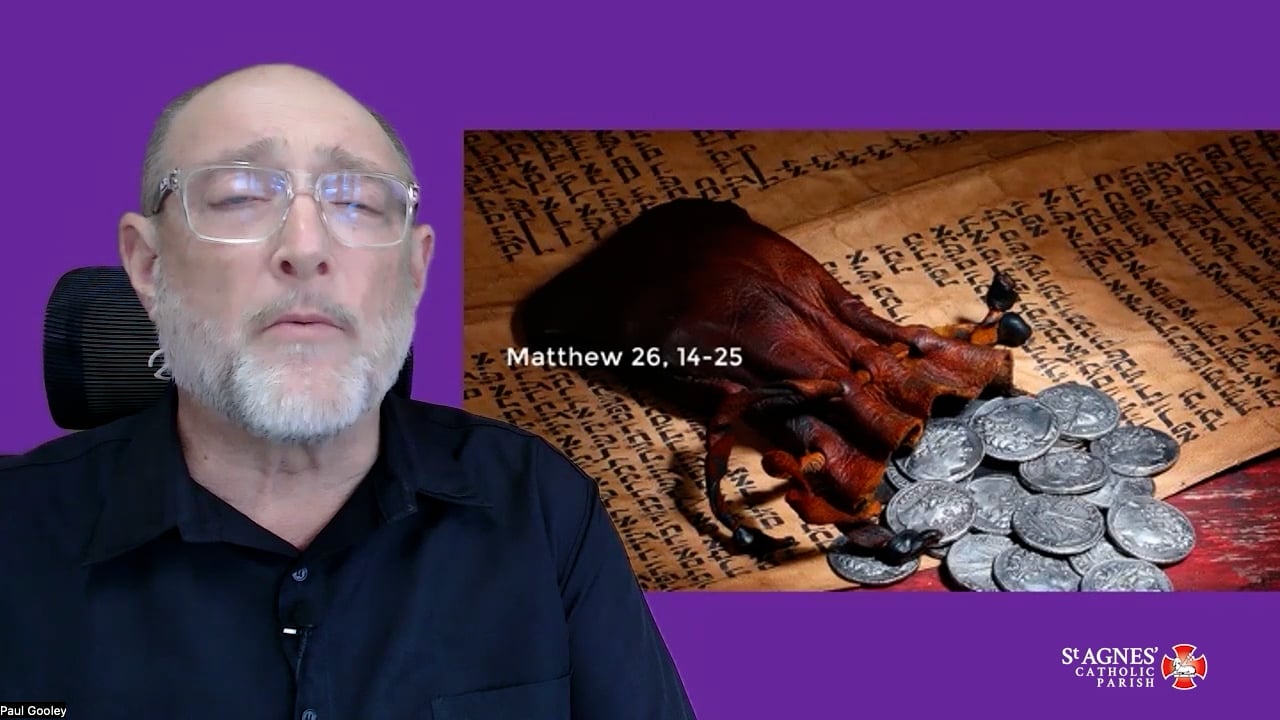
Gospel Reflection – Wednesday in Holy Week - According to the scriptures
14 Apr 2025Fr Paul Gooley reads from the Gospel of Matthew (26: 14-25) which commemorates the first part of the Last Supper, the preparation, and the betrayal.
Fr Paul says the strange pre-planned sequence of Jesus sending his disciples to encounter a seemingly random stranger in the city occurs both for Jesus’ solemn donkey ride into Jerusalem on Palm Sunday and for the preparation of a room for the Last Supper. These are evidence both of Jesus’ foreknowledge and of God’s own pre-planning: it was pre-destined that these events should take place as they did.
The events of Jesus’ life, but especially those of his Passion, Death, and Resurrection, were the culmination of God’s plan, expressed from ages earlier in the scriptures. The way this is shown is by relating even details of the happenings to the scriptures. So, in the earliest tradition, quoted by Paul in 1 Corinthians (15: 3-5), Christ died and rose again, both ‘according to the scriptures’.
And again, according to the scriptures, the thirty pieces of silver paid for the betrayal of Jesus is mentioned in Exodus (21:32).
Why did Judas betray his Master? Was it simply for thirty pieces of silver? Was Judas a convinced nationalist fighter who abandoned Jesus in frustration when he perceived that Jesus was not a political liberator who would expel the Romans? We will never know.
Fr Paul invites us to reflect on todays’ Gospel Lesson: The Last supper is prepared…. Are we ready?
Over the next few days, rather than a reflection, Fr Paul will share some explanations about the ceremonies to be celebrated at Easter and he encourages and invites us all to come along to experience for yourself the ceremonies he describes.
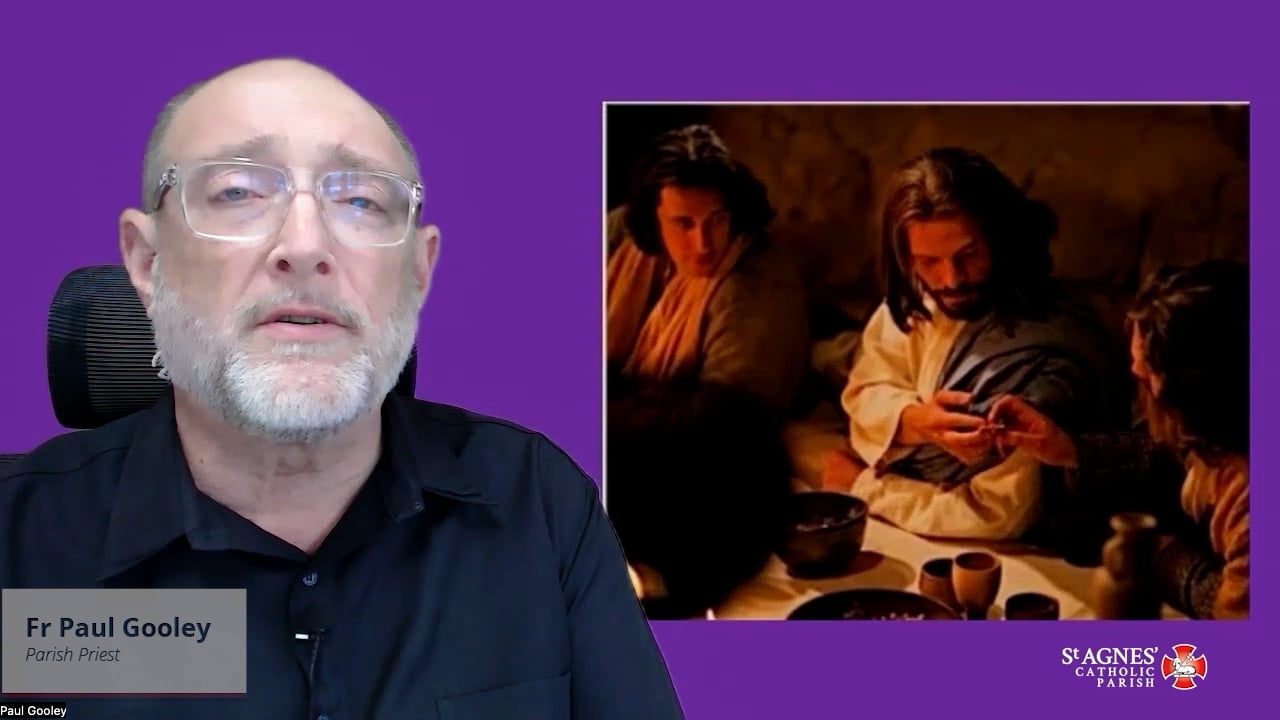
Gospel Reflection – Tuesday in Holy Week - The Last Supper
14 Apr 2025Fr Paul Gooley reads from the Gospel of John (13: 21-33, 36-38) which shares details of Jesus’s last meal with his disciples.
Fr Paul says rather than telling us the story of the Last Supper, the Gospel give us only two incidents at the Supper, that there is traitor, and the institution of the Eucharist. John identifies the traitor, but the synoptic Gospels of Mark, Luke, and Matthew stress not his identity by name but as one who dips his hand in the dish with Jesus.
The Church also puts before us the failure of the disciples, led by Peter. Throughout Jesus’s ministry this has been a theme, especially in Mark. Three times the disciples are rebuked for their failure to understand who Jesus is and, again, three more times they fail to grasp the teaching on suffering, that as the Messiah Jesus can only accomplish his mission by suffering and death, and that his disciples must share this suffering.
The theme reaches its climax with Peter’s repeated protests at the Last Supper that he is ready to die with Jesus and, yet, we know that he will deny knowing Jesus when he is challenged by the servant girl in the High Priest’s house.
In John, at any rate, we hear the story of Peter’s repentance and his response to the Risen Christ’s threefold challenge at the Lakeside. The prominence given to this theme is surely a reminder that the Twelve are role-models for future disciples even in their failure – and in their repentance.
Fr Paul says the lesson we might reflect on from today’s Gospel: Perfection is less important than repentance.
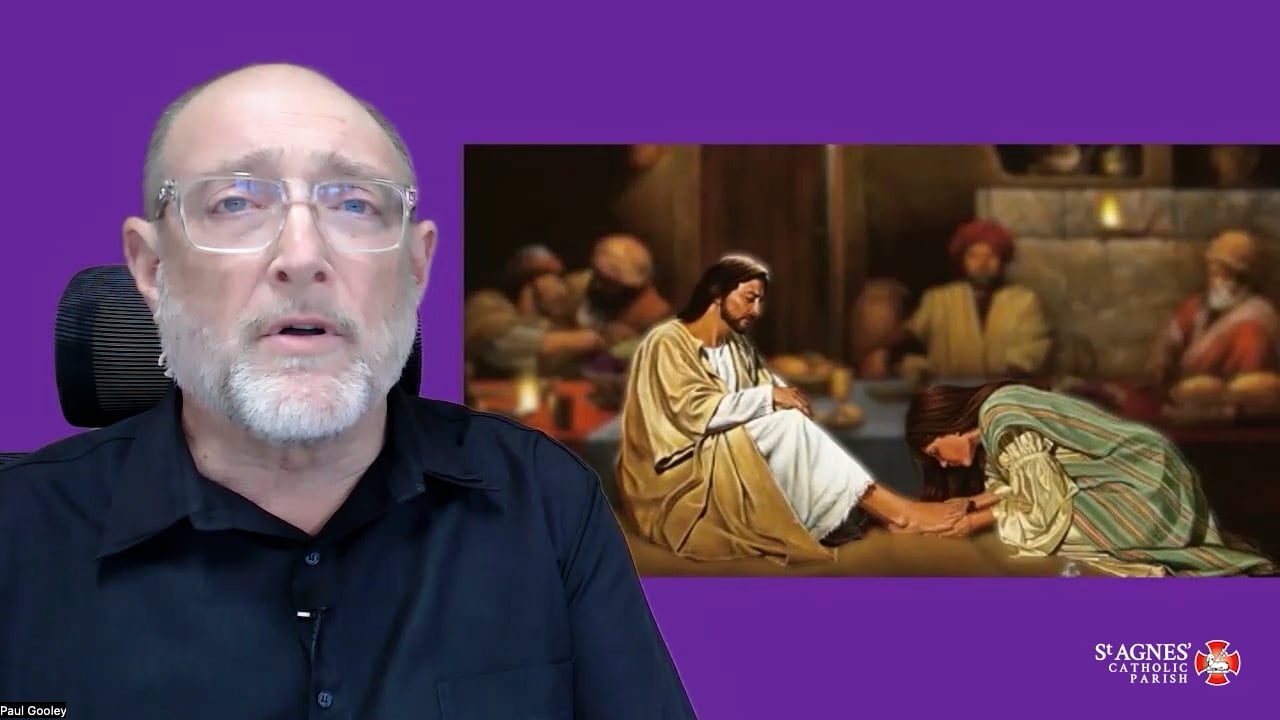
Gospel Reflection – John 12: 1-11 - An Act of Love
7 Apr 2025Holy Week began with Palm Sunday celebrations and today Fr Paul Gooley reads from the Gospel of John (12: 1-11) which tells the story of the anointing of Jesus’ feet with costly ointment at Bethany six days before he makes his way to Jerusalem for Passover.
Fr Paul says in Mark and Matthew Gospel’s the woman who anoints the feet of Jesus is unnamed, but John names her as Mary, sister of Martha and Lazarus. John is more familiar with Jerusalem and its environment than are Mark, Luke and Matthew, and may have the family as his source.
Mary’s act of loving, personal affection and devotion is treasured. John’s comment that the scent filled the house shows a touching approval, too. It will be remembered that Mary was the sister who stayed listening at Jesus’ side while Martha busied herself with practical details. This casts her as a figure of prayer and listening. Her sign of affection must have been valuable to Jesus as he rested at Bethany after the threatening controversies in the Temple. His response shows just how tense Jesus must have been.
So, at this tense moment it makes Judas’ response seem a bit brutal – no matter how practical it might have been on other occasions.
Fr Paul invites us to reflect on the challenge of today’s Gospel – Mary again sits at the feet of Jesus and as an act of love she prepares Jesus for burial so as Holy Week begins let us, too, sit and listen with love.
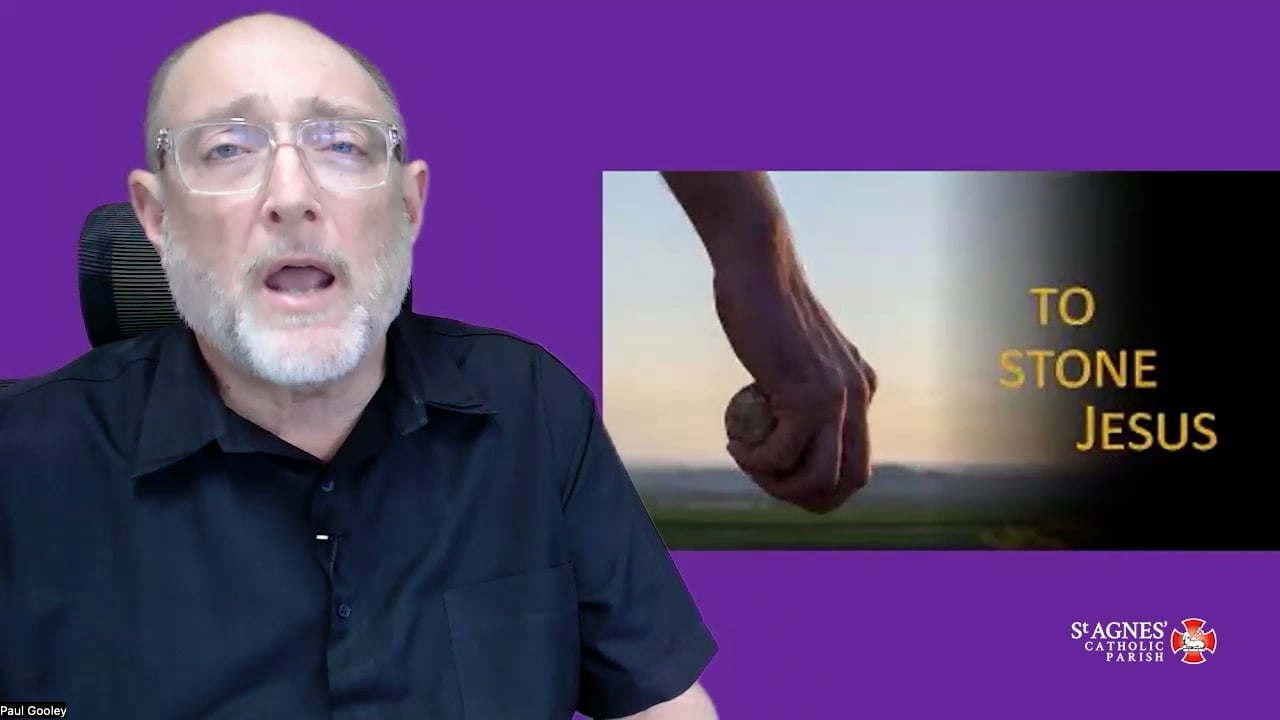
Gospel Reflection – John 10: 31-42 - To stone Jesus
7 Apr 2025Fr Paul Gooley reads today from the John (10: 31-42) in which the Jewish opponents picked up stones to stone Jesus.
Fr Paul says this scene of confrontation between Jesus and his opponents takes place at the Festival of the Dedication. This agrees with John’s theme that Jesus takes over, or centres in himself in, all the festivals of Judaism: he has already taken over the Sabbath by working on the Sabbath, for only God works on the Sabbath. He has taken over the festival of Tabernacles by claiming that he is the source of the living water which was a part of the ritual of the festival. He will take over the Passover by making it his own festival of the new covenant. So now he takes over the festival of the Dedication, saying that he is the one who was truly consecrated by the Father, not the Temple whose re-dedication was being celebrated.
In both Matthew and Mark gospels Jesus is accused of blasphemy for accepting the title of ‘Son of God’. Similarly in Johns gospel Jesus is accused of calling himself ‘Son of God’ and claiming the divine title and is charged with blasphemy for so doing. In either case the gospel writers are telling us that the crunch-point of the accusations against Jesus, the real reason for his condemnation, is his claim to be divine. It is not a matter of disputes over observance of the Law, not yet of the disturbance in the Temple, but it is his claim that he is divine.
For our reflection, Fr Paul says we might reflect on the divinity of Jesus.
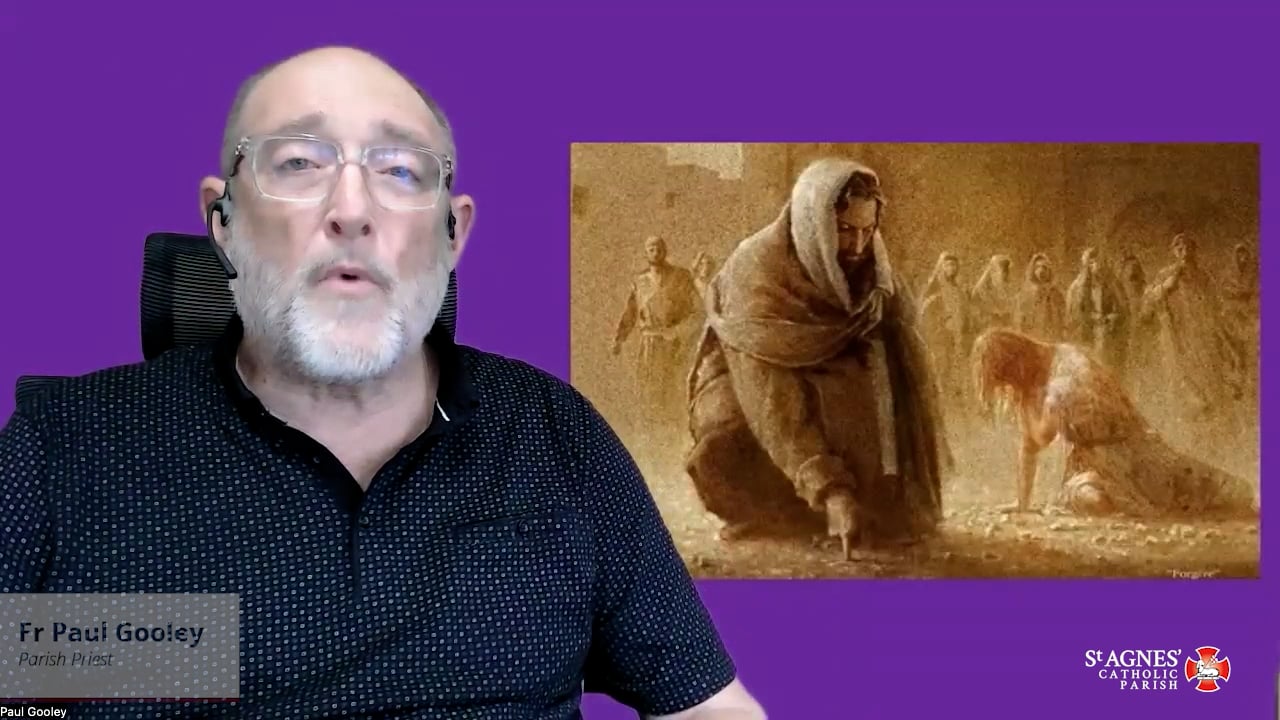
Gospel Reflection – John 8: 1-11 - Who is without sin
31 Mar 2025Fr Paul Gooley reads from the Gospel of John (8: 1-11) in which the scribes and the Pharisees bring a woman, who had been caught in adultery, to Jesus to test him and Jesus says to them, “If there is one of you who has not sinned, let him be the first to throw a stone at her.”
Fr Paul says this story does not really fit into the Gospel of John. We know that in early manuscripts of the Gospels it floated around in various positions before it becomes anchored as an example of Jesus’ saying just before, ‘Our Law does not allow us to pass judgement on anyone without first giving him a hearing’ (John 7: 51).
Fr Paul says he has always been curious - What was Jesus writing on the ground, or was he just doodling to allow the accusers time to reflect on their self-righteousness? It is made clear we understand that we cannot be a follower of Christ without first admitting our sinfulness. For example, Peter in the boat tells Jesus to leave, for he is a sinner. Zacchaeus promises to make multiple restitution for his embezzlements. The woman at the supper weeps for her sins at Jesus’ feet.
Fr Paul invites us to consider today’s Gospel Question – Am I like the Pharisee’s and act all self-righteous or do I have the humility to admit that I am a sinner?
Gospel Reflection – John 7: 40-52 - Who is Jesus?
31 Mar 2025Fr Paul Gooley reads from the Gospel of John (7: 40-52) in which the people disagree about who Jesus is; some say he is a prophet; others that he is the Christ; others, still, question his origins.
Fr Paul says the stubbornness of the opponents of Jesus becomes unmistakable. At first there is still a possibility of mistake, through the mistaken idea that Jesus came from, that is originated in, Galilee rather than Bethlehem. This provoked the sardonic comment about lack of prophets in Galilee. The Galileans were despised in the rabbinic schools of Jerusalem, to the extent that it was said that they could not even speak properly. This may have been a fair comment, or it might have been a gibe borne of rivalry between the rabbinic schools in Jerusalem and Tiberias.
Then the hostility mounts, as the leaders reply with sarcasm to the enthusiasm of the agents they had sent to arrest Jesus. This is followed by a further barrage of sarcasm against one of their own number, Nicodemus, who makes the unimpeachable protest that Jesus should at least be given a hearing. So, we have reached the point where no argument is going to shake their hostility.
The controversy whether Jesus was the Messiah (in Greek, the Christ) is understandable. ‘Messiah’ means ‘Anointed’, and the title had strong political overtones, the political overtones of an anointed ruler of the line of David. By some the Messiah was expected to be a glorious warrior who would sweep the Roman occupiers into the sea. For this reason, Jesus himself does not use the title until he is directly challenged by the High Priest.
Jesus’ concept of Messiah was utterly different from that of the Temple authorities. Jews contemporary to Jesus did not associate with the Messiah the prophecies of the Suffering Servant of the Lord, which was such a strong emphasis in the concept for Jesus himself. This was why Peter’s sudden realisation at Caesarea Philippi that Jesus was the Messiah had to be hushed up, and the disciples were not allowed to start spreading the message until after the crucifixion and Resurrection. It required repeated emphasis from Jesus and the dire experience of the Passion before the disciples came to realise what sort of Messiah he was.
As we continue our Lenten journey, Fr Paul invites us to ask ourselves - does my stubbornness get in the way of recognising who Jesus really is?
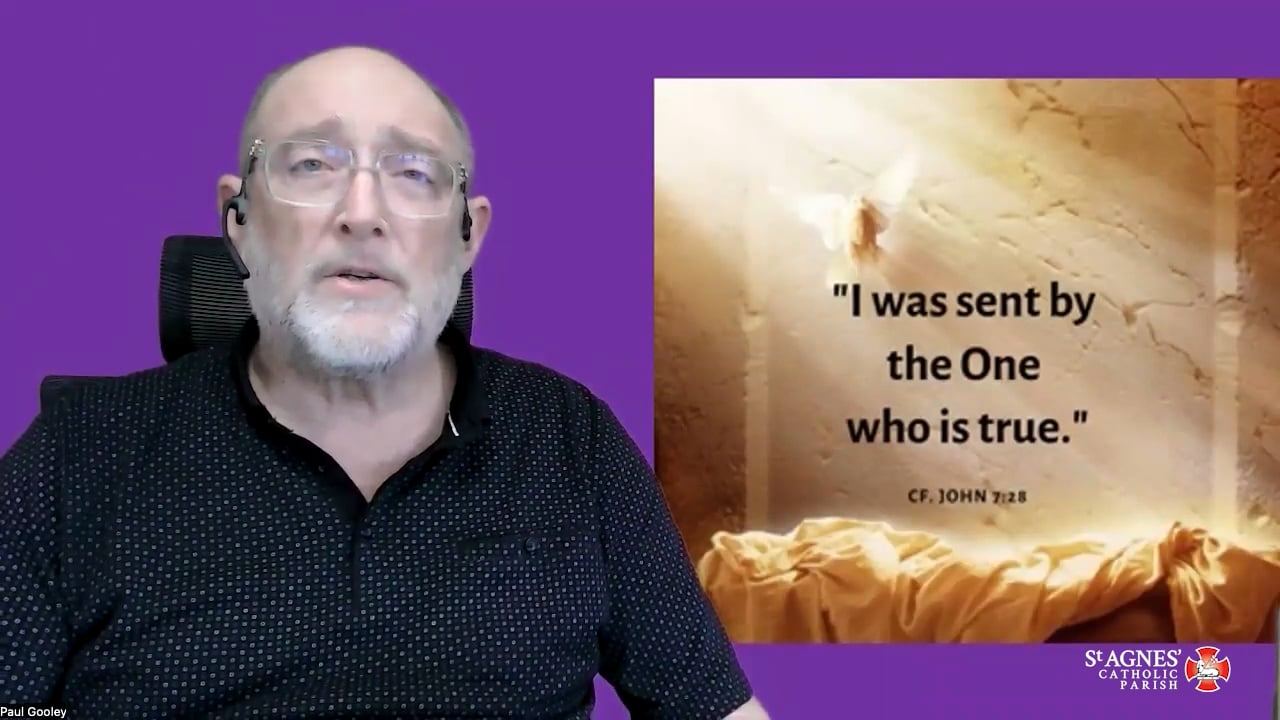
Gospel Reflection – John 7: 1-2, 10, 25-30 - Sent by the One who is true
31 Mar 2025Fr Paul Gooley reads from the Gospel of John (7: 1-2, 10, 25-30) in which Jesus proclaims, as he teaches in the temple, “You know me, and you know where I come from? But I have not come of myself; no, there is one who sent me, and I really come from him, and you do not know him. I know him, because I come from him, and it was he who sent me.”
Fr Paul says Jesus has gone up to Jerusalem for the annual Festival of Tabernacles or Sukkoth. On this festival the custom was and is to spend the time not in the house but in a leafy booth probably attached to the house. This commemorates the time spent in tents and temporary shelters during the desert wanderings. Jesus takes the occasion of his visit to Jerusalem to reiterate his relationship to ‘the One who sent him’, continuing the witness we have heard in the last three gospel readings
‘The Jews’ still cannot take control of him ‘because his Hour has not yet come’ and this ‘Hour’ provides a thread running through the Gospel of John. It appears first, and mysteriously appears, at the marriage-feast of Cana, where Jesus initially refuses his mother’s request on the grounds that his Hour has not yet come.
Then in this controversy on the Festival of Tabernacles it still has not yet come. Finally, at the beginning of the Last Supper, he sees that the Hour has come (13.1). It is the Hour of his Glorification (17.1-2) when he is to be lifted up from the earth. With typical Johannine ambiguity this ‘lifting up’ is both physical, exalted onto the Cross, and metaphorical, exalted and glorified by and with his Father.
Fr Paul invites us to consider today’s Gospel Question – The hour has not yet come for us either. We are in the final days of Lent. What do I really need to do in Lent before the hour of our Easter Celebration comes?
Gospel Reflection – John 5: 31-47 - Bearing witness
31 Mar 2025Fr Paul Gooley reads from the Gospel of John (5: 31-47) in which Jesus says, “my testimony is greater than John’s; the works my Father has given me to carry out, these same works of mine, testify that the Father has sent me”.
Fr Paul says this Gospel reading continues the confrontation of Jesus with the Jewish leaders on the Temple. Jesus cites the testimonies which bear witness to him.
First the testimony of John the Baptist (v. 31-35). This was especially important because in the synoptic Gospels – the Gospels of Matthew, Mark and Luke, when Jesus is challenged about his own authority he replies, asking them to explain John’s the Baptist’s authority, and they do not dare to answer, for John had been so revered. The Gospels represent the beheading of the Baptist as a palace-party-gone-wrong. The Jewish historian Josephus, however, says that Herod Antipas imprisoned John because he was afraid that he would start a rebellion; so, he had, obviously, a considerable following.
The second testimony is that of the works which the Father has given Jesus (v. 35-36). Again, in the synoptic Gospels the wonderful works of Jesus in healing, restoring, gathering in sinners and outcasts, are all manifestations of the coming of the Kingship of God. In the Gospel of John, they are signs that Jesus is doing the work of the Father.
The third witness is the testimony of the Father (v. 37-38). Since they do not receive this testimony, ‘his word finds no home in you’.
The fourth witness is the scriptures (v. 39-47), a witness which the Jewish authorities refused to accept. Consequently Moses, on whom they rely, will be a witness against them. In the formation of the New Testament the fulfilment of the scriptures was particularly important. Even the oldest creedal testimony, given by Paul in 1 Corinthians 15.3-5, twice mentions ‘according to the scriptures’ – both Jesus’s death and his resurrection. The Jews, however, would not accept that these scriptures witnessed to Jesus.
Fr Paul invites us to consider today’s Gospel Question – How many times does Jesus need to prove who he actually is? Or like the Jewish Leaders do we just write him off too?
Gospel Reflection – John 5: 17-30 - Hear my word and believe
31 Mar 2025Fr Paul Gooley reads from the Gospel of John (5: 17-30) in which Jesus says to the Jews, “The Son can do nothing by himself; he can only do what he sees the Father doing; and whatever the Father does, the Son does too".
Fr Paul says in the passage just before this Gospel, Jesus was being attacked by ‘the Jews’ for working on the Sabbath. They were especially upset at Jesus claiming the right to work on the Sabbath, because only God has to work on the Sabbath – babies are born (he has to give them life) and people die (he has to judge them).
In this passage, Jesus now reflects on the witness given by the healing to the relationship between him and the Father. This reflection is perhaps the clearest and richest statement of the relationship between Father and Son all in the Gospels.
This Johannine passage is a dynamic definition, in terms of will and power and function.
At beginning and end the passage is bracketed by the statement that Father and Son have the same will: there is no distinction in what they desire and do: whatever the Father does, the Son does too (v. 19), and ‘I seek not to do my own will but the will of him who sent me’ (v. 30).
In more detail, to give life is the supreme prerogative of God, for no one else can give life. But just as the Father gives life, so the Son gives life (v. 21 and 25). Only the power to give life comes to the Son from the Father (v. 26). This does not mean that the Son is inferior to the Father; far from it, for they both have the same power, though in the Son it is a derivative power.
Similarly, it is also the function of God to judge (v. 22 and 27). The Father judges no one but has given all judgment to the Son. But the Son, in his turn, judges no one, for throughout the Gospel we see human beings judging themselves by their reaction to Jesus. But here again, the Son’s function in judging, though total and absolute, is derivative, for the Father ‘has entrusted all judgment to the Son so that all may honour the Son as they honour the Father.’
Fr Paul invites us to consider today’s Gospel challenge – Let us take some time to reflect on the relationship between the Father and the Son.
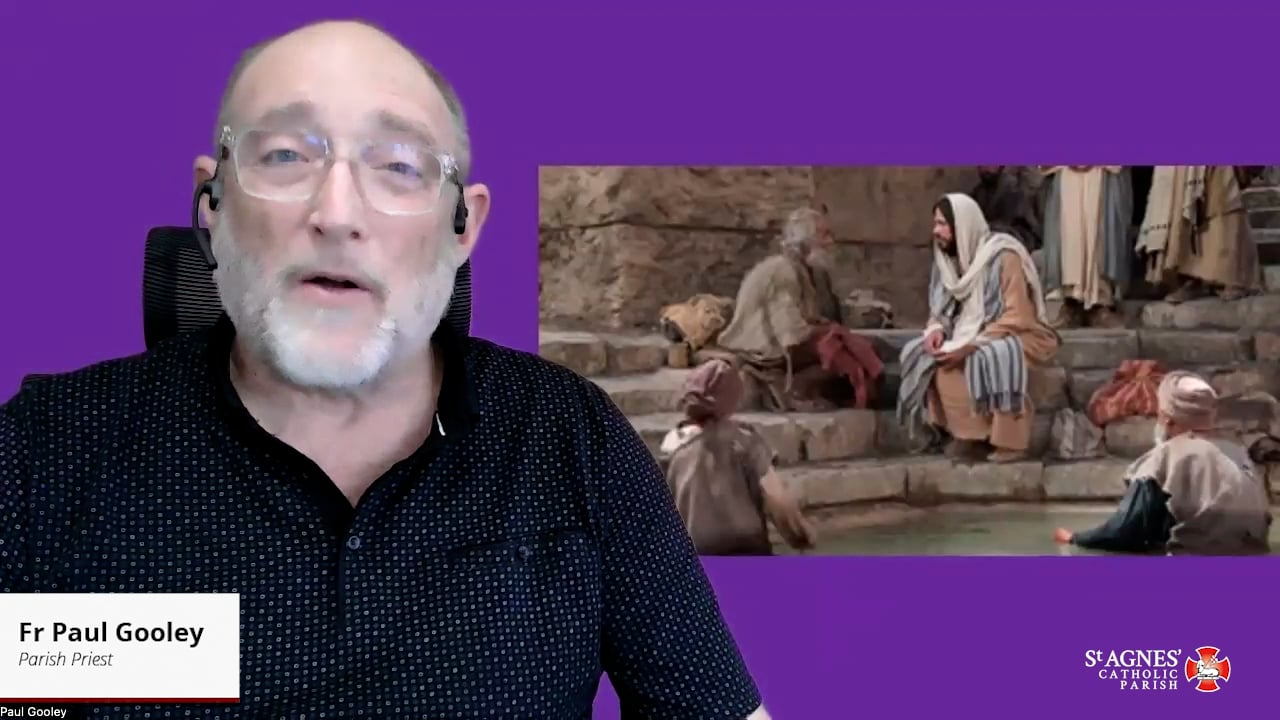
Gospel Reflection – John 5: 1-3, 5-16 - Healing at the Pool
31 Mar 2025Fr Paul Gooley reads from the Gospel of John (5: 1-3, 5-16) in which Jesus heals a man on the Sabbath, who had been at the Pool of Bethzatha for many years.
Fr Paul says today we hear the story of Jesus’ marvellous healing at the Pool of Bethzatha (Bethesda). Jesus’ reflection on the healing and on the witness it provides will give us the Gospel reading for the next three days.
On the gentle slope running down from the north into the Temple there is an artificial reservoir to gather the water flowing off the hillsides for a short time after heavy rains. Surrounding the pool are five colonnades – or rather four colonnades surrounding and one across the middle, dividing it into two pools. This is called the Pool of Bethzatha, and part of the steps down into it still exists – so the author of the Gospel knows Jerusalem well. Around the Pool are still the remains of little healing-shrines, for it was obviously a place where sick and handicapped people came expecting to be healed.
Jesus comes to the Pool and takes pity on one sufferer who has been waiting 38 years – and all the authorities can do is complain that he should not ‘work’ on the Sabbath!
The Gospels of Matthew, Mark and Luke tell us that Jesus only made one visit to Jerusalem, just at the end of his ministry, but in John’s Gospel there are four visits to Jerusalem.
With the extra visits to Jerusalem provided by John we can see Jesus acting in Jerusalem as he did in Galilee. Again, his interpretation of the Law is the same: no Sabbath obligation can stand in the way of Jesus’s love and care for individuals.
Fr Paul invites us to consider today’s Gospel Question – What stands in the way of my being able to love and care for others as Jesus did?
Gospel Reflection – John 4: 43-54 - Jesus heals the official’s son
24 Mar 2025Fr Paul Gooley reads from the Gospel of John (4: 43-54) in which an official from Capernaum went to Jesus and begged him to come and heal his son, who was close to death.
Fr Paul says the story of the official’s son comes in three of the Gospels (not Mark), with slight variations. Here, in John’s account, it is the son of a court official, which fits the fact that Galilee in the time of Jesus was ruled by Herod Antipas, who boasted an extensive court – it was for their entertainment that he had John the Baptist beheaded.
In the Matthew/Luke tradition it is a centurion, possibly Roman but more likely a gentile mercenary. Luke stresses that he had earned the attention of Jesus by paying for the building of a synagogue. In each tradition the official is the paradigm of gentile faith in Jesus.
At the end of the account of the cure of the boy John mentions that this was the second sign given by Jesus. The first twelve chapters of John contain seven signs and are often known as ‘the Book of Signs’, for in John the miracles of Jesus have a subtly different sense from that of the other Gospels.
In the other Gospels the miracles show the beginning of the Kingship of God, Jesus’ triumphing over disease, blindness, alienation and death, and so ushering in the Kingship of God.
In John the miracles are often explicitly called ‘signs’ and they are signs of spiritual values and of Jesus’s own glory. Thus, the first sign at Cana, the conversion of the water of Jewish purification into wine, is a sign of the wedding-feast of the Messiah, the joyful union of God with his people. Our present story is the second sign, the gift of life. In John life always has at least the overtones of eternal life, for Jesus has come to give eternal life.
As we continual our Lenten Journey, Fr Paul invites us to consider – What do I need to do to have life?
Gospel Reflection – Luke 18: 9-14 - God values humility
24 Mar 2025Fr Paul Gooley reads from the Gospel of Luke (18: 9-14) in which, a tax collector, visits the temple and, not even looking up to heaven, beat his breast saying, ‘God, be merciful to me, a sinner’.
Fr Paul says Luke is the evangelist of prayer, and he frequently hints about it.
In this Gospel, Jesus is explicitly mentioned as being in prayer more often than in any other, at the Baptism, the Transfiguration, when called upon to teach his disciples the Lord’s Prayer (3: 21; 6: 12; 11: 1). The Agony in the Garden is shaped to show the need for prayer in time of testing (2: 40). In the Infancy Narratives his characters burst into prayerful praise on every occasion, and from these we derive the three great canticles of the Church, the Magnificat, the Benedictus and the Nunc dimittis. His parables insist on the need for perseverance in prayer, especially the parables of the Friend at Midnight (11: 5-8) and the Unjust Judge (18: 1-5). So, the message is to persevere!
Today, in this parable of the Pharisee and the Tax-Collector, Luke combines the serious with humour in a typically Lukan way. The pompous and self-contradictory bragging of innocence by the Pharisee is to be avoided, while the humble self-accusation of the tax-collector is something to which we can all aspire.
Fr Paul invites us to consider today’s Gospel Question – Am I humble enough to admit my faults and failings and ask for God’s forgiveness?
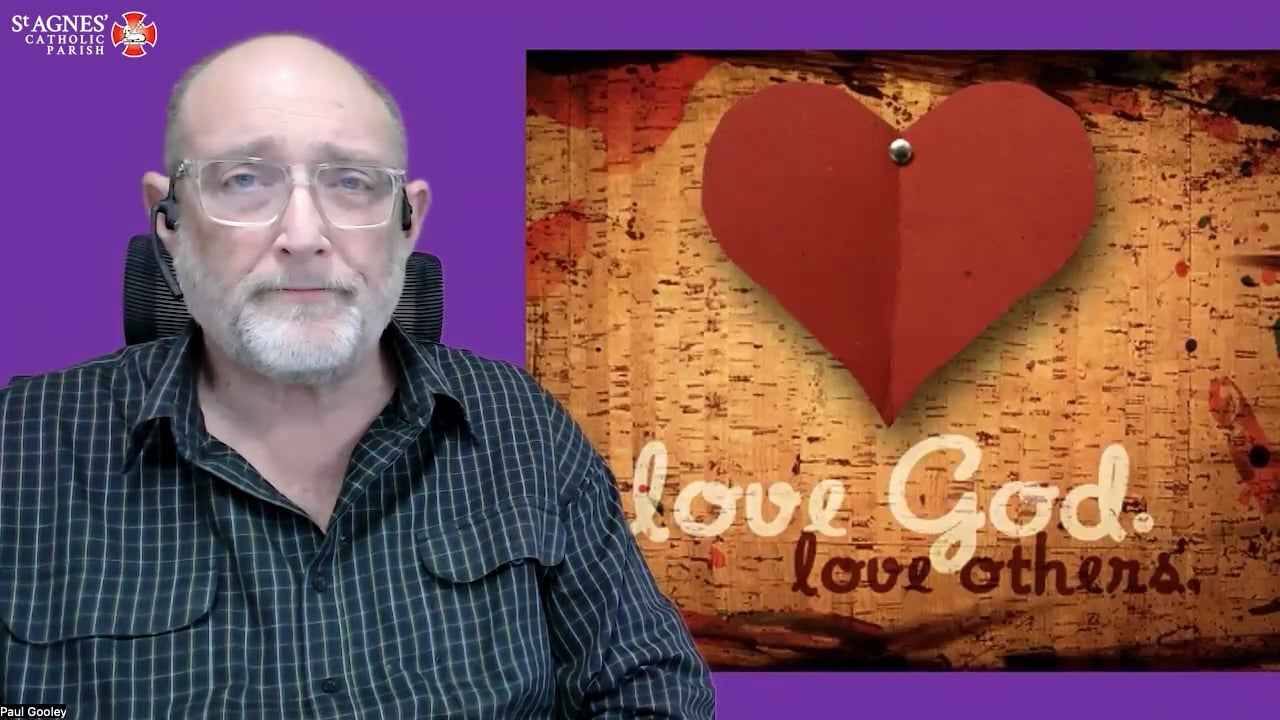
Gospel Reflection – Mark 12: 28-34 - Love God – Love others
24 Mar 2025Fr Paul Gooley reads from the Gospel of Mark (12: 28-34) in which, when asked about the greatest commandment, Jesus says, “Love the Lord your God with all your heart, with all your soul, with all your mind and with all your strength. The second is this: ‘Love your neighbor as yourself.’ There is no commandment greater than these.”
Fr Paul says the Pharisees have a bad name, but they really shouldn’t. They, among all the parties of the Jews, were concerned above all to live holy lives and to keep the traditions and the Covenant. The vices they are reproached for, having concern about minor details and rules such as pedantry and being fussy, and even hypocrisy, are occupational hazards of any group of people that try to do good. From ‘I am doing good’ to ‘I am good’ is a small step, and from ‘I am good’ to ‘anything is good if I do it’ is another small step. We see it often even today. As the saying goes, the best, corrupted, becomes the worst.
Thus, the most positive, you might even say the most intimate, contacts between Jesus and the Jewish establishment come when he is talking to a scribe or a Pharisee. Here is one of the best, and the most instructive. There is no suggestion in this Gospel that this Pharisee lawyer was trying to trick Jesus; he was just asking this teacher a typical Jewish question about priorities because he wanted to know the answer.
Jesus replies with an impeccable Rabbinic answer, bringing together two texts from different books of the Bible. In bringing them together he is using an acknowledged principle of exegesis: if two texts share the same words, they should be interpreted together. The two texts which Jesus uses are the only two in the Bible that have the words ‘and you shall love’ with a direct object.
The first, about love of God, is from the basic confession of faith in Deuteronomy, recited by every faithful Jew three times a day, ‘And you shall love the Lord your God with all your heart, mind and strength’.
But the exciting thing about the answer is that Jesus couples that with another text from Leviticus, ‘And you shall love your neighbour as yourself’. The command is not new, but it is staggering that Jesus puts it on a level with the other.
So, again and again Jesus shows his mastery of the scriptures, a more profound understanding, going straight to the heart of the major texts of the Bible.
Fr Paul invites us to consider: In Lent how can I show my love of God and love of neighbour?
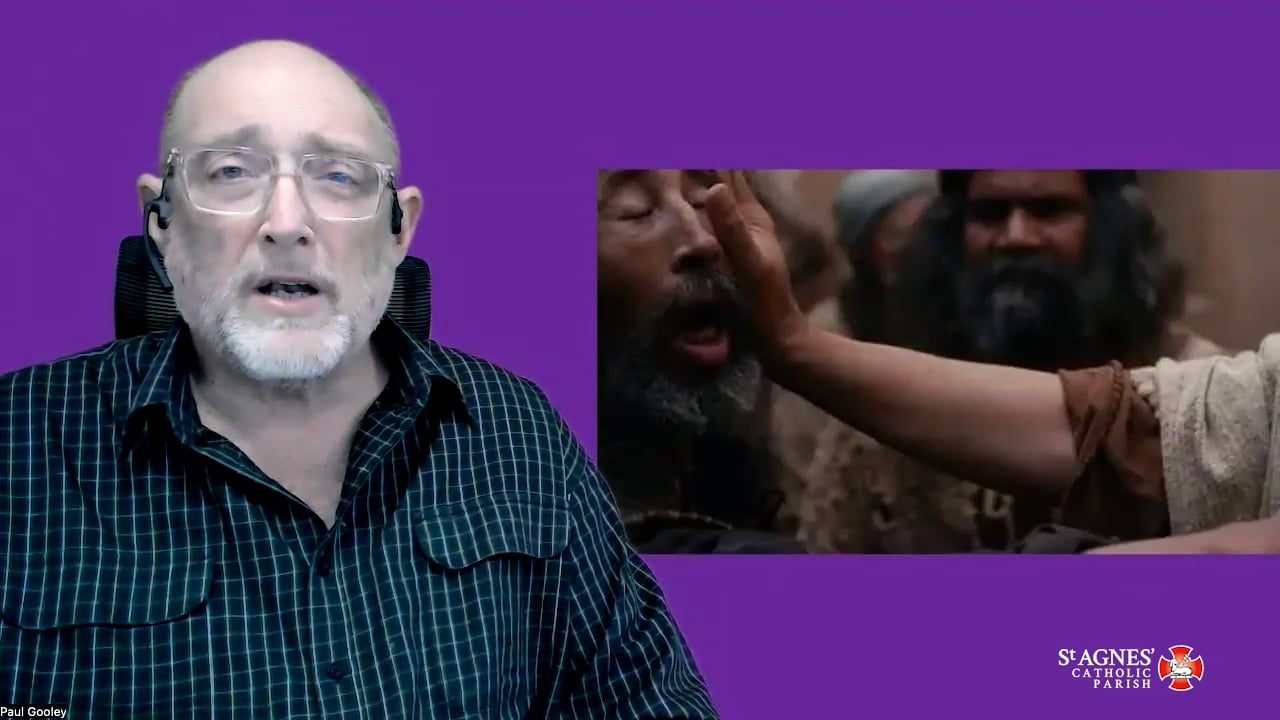
Gospel Reflection – Luke 11: 14-23 - The healing power of Jesus
24 Mar 2025Fr Paul Gooley reads from the Gospel of Luke (11: 14-23) in which Jesus says, “Every kingdom divided against itself is heading for ruin, and a household divided against itself collapses”.
Fr Paul says in the Gospel passage Jesus is accused of being in league with the Prince of Demons. The name of the prince of demons, ‘Beelzebul’, has never really been satisfactorily explained.
However, the interest of the passage is that, by ascribing Jesus’s exorcisms to the Prince of Demons, his opponents are at least admitting that he did cast out demons. What should we say about the healing activity of Jesus? In the primitive state of medical knowledge at the time diseases could often be ascribed to demonic possession.
It is impossible to calculate the effect on a person suffering from illness of any kind when they meet the powerful and awesome personality of Jesus. Such an encounter might have an immediate and stunningly effective outcome.
The Gospels are trying to give us an account of what happens when a sick person meets the divinity of Jesus because Jesus is not just a human person.
Fr Paul invites us to think about today’s Gospel Lesson – If I was to meet Jesus today, what would need healing in my life?
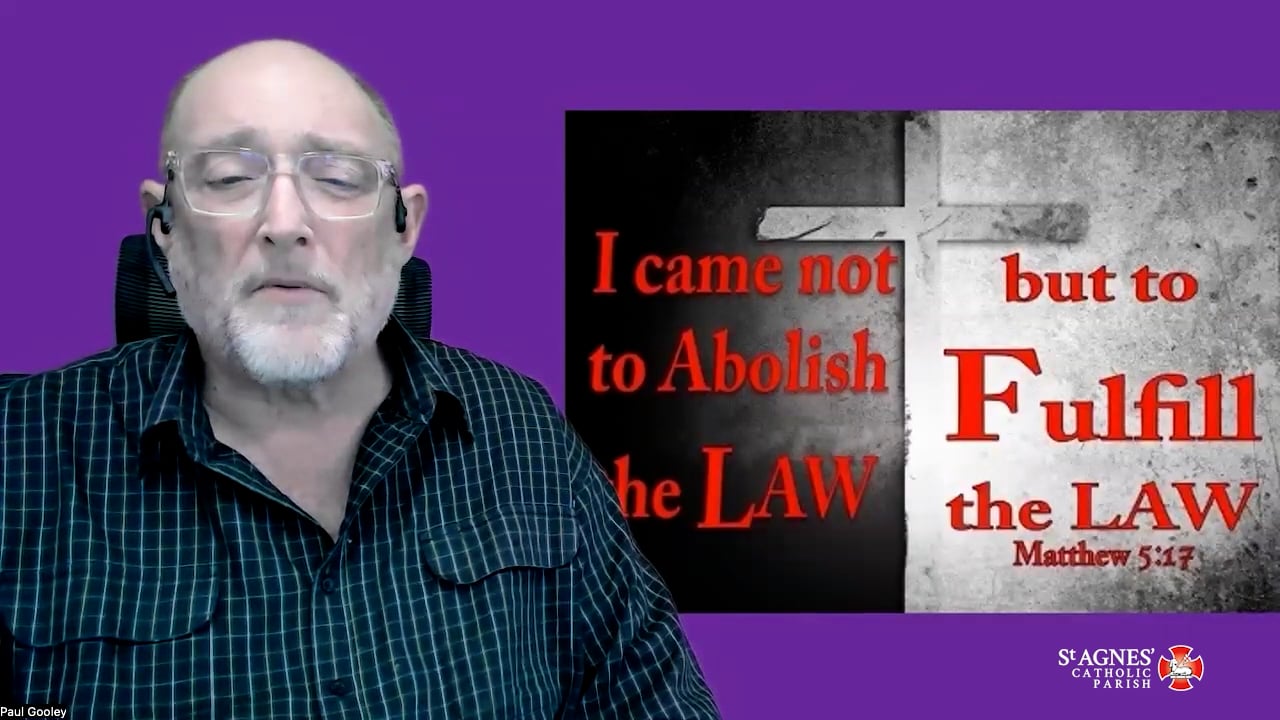
Gospel Reflection – Matthew 5: 17-19 - Jesus came to fulfil the law
24 Mar 2025Fr Paul Gooley reads from the Gospel of Matthew (5: 17-19) in which Jesus says, “Do not imagine that I have come to abolish the Law or the Prophets; I have come not to abolish but to complete them”.
Fr Paul says God’s covenant with Moses on Mount Sinai was the basis of Israel’s life. It gave the terms under which Israel were to be God’s people, and so a revelation of the nature of God himself.
So much of Christianity comes straight from the Law, not only beliefs but also behaviour.
And yet Jesus, while remaining faithful to the Law, gives it his own emphases, often quoting the Bible itself. ‘My pleasure is in mercy not sacrifice’ (Hosea 6: 6, quoted by Jesus in Matthew 9: 13) gives a whole new dimension to worship and forgiveness. Putting love of neighbour on a level with the first commandment of love of God (bringing Leviticus 19: 18 to the level of Deuteronomy 6: 4, as in Mark 12: 29) gives a new emphasis on the treatment of others. Perhaps most of all, it was Jesus’ awareness of the full meaning of what it is to be the Servant of the Lord God prophesied in Isaiah, that led to his act of perfect, loving obedience on the Cross.
The Aramaic word ‘Amen’ must have been one of the features of Jesus’ teaching. The basic idea of the word is ‘truth, firmness, reliability’. It is used frequently in the Old Testament to express acceptance of or agreement with a statement, prayer or oath of another, ‘I agree’.
When Paul teaches that Jesus is the ‘Amen’ to all God’s promises (2 Corinthians 1:20) he means that Jesus is the confirmation or certainty of God’s promises. In the Gospel of John Jesus frequently doubles the expression for strong emphasis.
Fr Paul puts today’s Gospel Question to us – We might live faith-filled, law-abiding lives but like Jesus how can we do more?
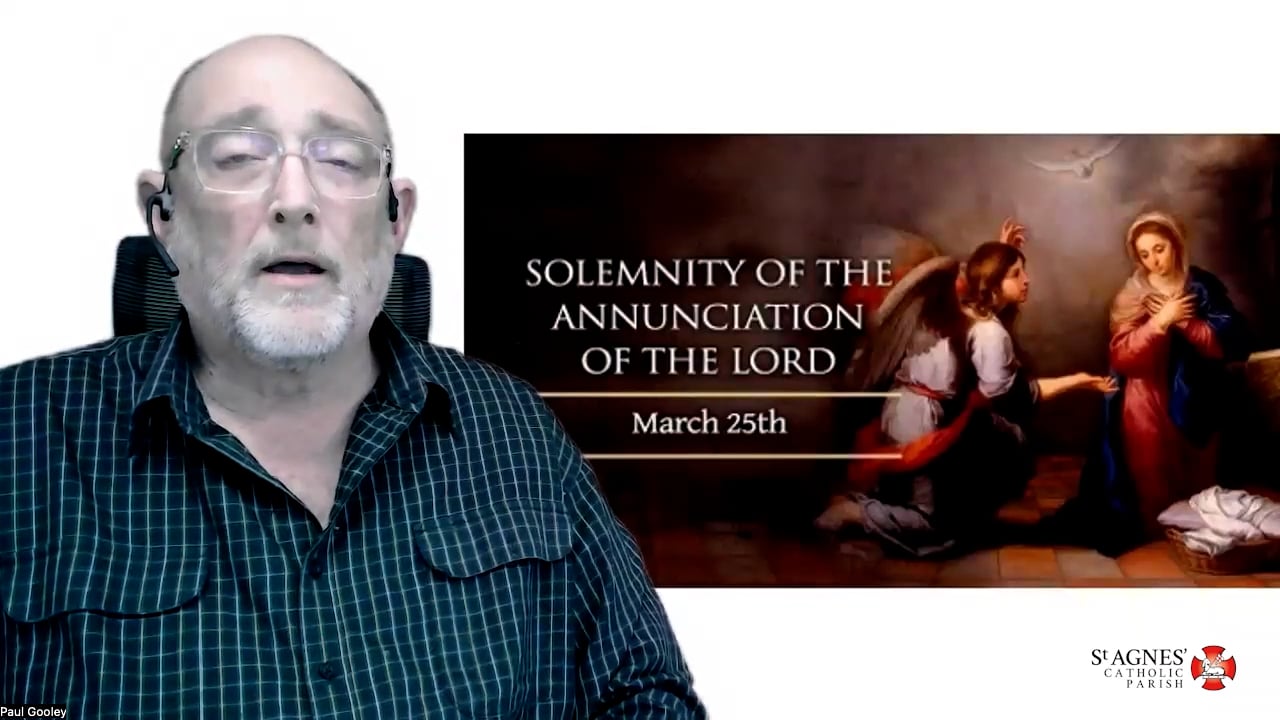
Gospel Reflection – Luke 1: 26-38 - The Annunciation of the Lord
24 Mar 2025Fr Paul Gooley reads from the Gospel of Luke (1: 26-38) in which Mary is greeted by the Angel Gabriel saying “Rejoice so highly favored! The Lord is with you” and she responds to God’s request saying, “I am the handmaid of the Lord, let what you have said be done to me”.
Fr Paul says the Annunciation, which is also called Annunciation to the Blessed Virgin Mary or Annunciation of the Lord is the announcement by the angel Gabriel to the Virgin Mary that she would conceive a Son by the power of the Holy Spirit and that Son is to be called Jesus (Luke 1:26–38). The angel’s pronouncement is met with Mary’s willing consent (“Here am I, the servant of the Lord; let it be with me according to your word”) and thus precipitates the Incarnation of Christ and his redemption of the world.
The Feast of the Annunciation is one of the principal feasts of the church and is celebrated on March 25, nine months before Christmas. The first authentic mentions of the feast, apart from the Gelasian and Gregorian sacramentaries, both of which mention the feast, are in acts of the Council of Toledo (656) and of the Trullan Council (692). The Annunciation had a particularly important place in the arts and church decoration of the early Christian and medieval periods and in the devotional art of the Renaissance and Baroque.
Gospel Reflection – Luke 4: 24-30 - No prophet is accepted in his hometown
18 Mar 2025Fr Paul Gooley reads from the Gospel of Luke (4: 24-30) in which the people in the synagogue at Nazara were upset when they heard Jesus say, ‘no prophet is accepted in his hometown’.
Fr Paul says the full impact of this Gospel scene becomes apparent only when we remember that it occurs at Nazareth, and it occurs right at the very beginning of Jesus’ ministry. It is Jesus’ declaration about the opening and setting of his ministry. It is essentially a story of non-conversion: the Nazarenes have been given the chance to be the first recipients of Jesus’ message, and they have turned it down. They think they know him, but they really don’t! So, Jesus will be forced to turn to the gentiles, as did Elijah and Elisha, bringing God’s healing to Syrians rather than to God’s Chosen People.
This passage does not occur in the other Gospels. Here Luke is already looking ahead to the gentile mission which he will outline in the Acts of the Apostles: three times Paul is rejected by the Jews. Three times he is forced to leave the Jews and bring Christ’s message to the gentiles: in Asia, in Greece and finally in Rome. Jesus is, after all, the light of the world, not only the glory of his people, Israel.
Fr Paul invites us to consider today’s Gospel Lesson - Do we really know who Jesus is? Do we only accept him when it suits us?
Gospel Reflection – Luke 15: 1-3, 11-32 - Jesus’ story of two lost sons
18 Mar 2025Fr Paul Gooley reads from the Gospel of Luke (15: 1-3, 11-32) in which Jesus tells a parable of the man with two sons, the younger one of whom asks for his share of the estate and then goes and squanders it.
Fr Paul says today’s gospel reading gives us a particularly attractive Lukan story of forgiveness. The story of the Prodigal Son is told with all Luke’s love, artistry and delicacy for the characters in the story.
The wasteful, good for nothing son goes back home not because he is repentant, but simply because he is hungry.
The loving father is perpetually on the look-out, despite the fact that the boy has written his father off with his implied ‘I don’t care whether you are alive or dead, I want my money’. He runs to meet the son, interrupting the carefully prepared speech and pampering the returned son. A chicken would have made a good party, or perhaps a lamb; but a fattened calf will feed the whole village!
When the father loves the elder son enough to leave his guests at the party and go out into the field, the disgruntled son slanders his brother and is gently corrected by his father.
Luke’s characters are always a bit like ourselves, good and bad at the same time. In this parable, the sons and the father often reflect on their situation and ask, ‘What shall I do now?’
Fr Paul invites us to consider today’s Gospel Lesson – Lent reminds us that we cannot forget the overflowing love and forgiveness of God.
Gospel Reflection – Matthew 21: 33-43, 45-46 - Parable of the wicked tenants
18 Mar 2025Fr Paul Gooley reads from the Gospel of Matthew (21: 33-43, 45-46) in which Jesus tells a parable about the landowner whose vineyard is leased to wicked tenants.
Fr Paul says Jesus’ understanding of the power or authority of God brought him the violent opposition of some of the Jewish leaders. In the Gospels of Mark and Matthew this parable, not surprisingly, introduces a series of confrontations with the Jewish leaders. The noose is beginning to tighten. It makes you wonder, were these leaders corrupt, or were they just closed to any new way of thinking, so closed that they could not see that Jesus was the promised Messiah?
Anyway, Jesus used this story about the tenants of a vineyard to show that they were not leading the people as they should. Everyone Jesus talked to would immediately understand the image of the vineyard. The prophet Isaiah – and many others after him – had used this image of the vineyard eight centuries earlier.
Does this mean that we have to follow every new idea? No, but it does mean that we must be open to the idea and that we may be wrong, that our service of the Lord may be faulty, that people we find tiresome or unacceptable may have more good in them than we give them credit for. God’s ways are not our ways, and we need to watch out for the bend in the road.
Fr Paul invites us to consider today’s Gospel Lesson – Unlike the Jewish Leaders am I open to new ways of thinking?
Gospel Reflection – Luke 16: 19-31 - Lazarus and the rich man
17 Mar 2025Fr Paul Gooley reads from the Gospel of Luke (16: 19-31) in which Jesus tells the parable of the rich man and the poor man, Lazarus.
Fr Paul says this story about Jesus only happens in Luke and it is another stark warning of the danger of wealth.
For Fr Paul there are three particularly horrible features of today’s parable:
Firstly, the flea-ridden dogs licking Lazarus’ sores: there were usually no pets as we know it in Palestine; dogs were either bristling guard-dogs or mangy strays.
Secondly, the rich man’s continuing self-absorption: even after death he still does not recognise Lazarus’ existence and thinks only of his own burning tongue; contrast this with the gentleness of Abraham who is caring for Lazarus.
Thirdly, the sheer stubbornness of the brothers; they are just not willing to listen, even to the most startling of events like rising from the dead. Nothing will distract them from their own selfish pre-occupations.
Fr Paul notes today’s Gospel Lesson – Lent is a time of giving.
Gospel Reflection – 19 March – Matthew 1: 16, 18-21, 24 - St Joseph
17 Mar 2025Fr Paul Gooley reads from the Gospel of Matthew (1: 16, 18-21, 24) in which an angel of the Lord appears to Joseph in a dream, telling him, ‘do not be afraid to take Mary as your wife, because she has conceived in her is by the Holy Spirit’.
Fr Paul says we know nothing else about St Joseph except what is said about him in the Gospels. He was a carpenter; he accepted the will of God; and he supported Mary and brought up Jesus. From the human character of his own son, we can see that he was a good and responsible father. He is widely venerated as a patron saint of artisans who honourably do good work with the gifts God has given them, and of workers in general.
To those who exercise the role of an adoptive parent, whether formally or informally, whether over one child or as the support of a whole family, Joseph is a source of inspiration.
Today, Fr Paul invites us to ask, ‘St Joseph…Pray for us.’
Gospel Reflection – Matthew 23: 1-12 - God’s cure for hypocrisy
17 Mar 2025Fr Paul Gooley reads from the Gospel of Matthew (23: 1-12) in which Jesus says to the crowds and to his disciples: “The scribes and the Pharisees occupy the chair of Moses. You must, therefore, do what they tell you and listen to what they say. But do not be guided by what they do, since they do not practice what they preach”.
Fr Paul says this chapter of Matthew’s Gospel contains the worst of what Matthew has to say about the scribes and Pharisees. It introduces a sevenfold curse upon them. The Pharisees were the group of the Jews that were most concerned about the exact observance of the Law of Moses. The ‘scribes’ were lawyers who the Pharisees could turn to in the case of a clash between two laws. It is good to follow laws and good to be able to work out what the laws are telling us to do, but the Pharisees’ and scribe’s attention to detail often made them lose sight of the real purpose of the Law.
Jesus was prepared to meet the Pharisees on their own ground and debate with them in their own terms. Remember, too, that the Pharisees took no part in the condemnation and death of Jesus; the Sadducees, who were in charge of Jerusalem were his opponents.
Argument about legal observance is part of the Jewish way of life, even today, and the controversies in the story of Jesus could well have been in-house discussions about the interpretation of the Law, rather than hostile confrontations. He even used – and used brilliantly – the Pharisaic method of quoting the Law in arguments, setting text against text, and the recognised rules of interpretation. He uses this technique to put the Law of love of neighbour on the very same level as love of God.
In the gospels, and especially in Matthew, written towards the end of the century, the hostility to this group has obviously become fiercer, no doubt because of their persecution of the followers of Jesus. As Matthew warns, ‘they will flog you in their synagogues.’ One of their concerns was obviously the status of the religious leaders. It looks as though they were turning into little gods on their own. This was a danger in Judaism, where specialised interpreters of the Law were required and honoured; there were many rabbis (‘my great one’) in Israel.
Fr Paul invites us to consider today’s Gospel Lesson: Rather than seeking greatness, how can I serve others. How can I live a humble life?
Gospel Reflection – Mark 10: 17-27 - With God all things are possible
24 Feb 2025Fr Paul Gooley reads from the Gospel of Mark (10: 17-27) in which Jesus says, “With man this is impossible, but not with God; all things are possible with God.”
Fr Paul says, in this Gospel we meet a rich young man who approaches Jesus with a big question: "What must I do to inherit eternal life?" He tells Jesus that he has followed all the commandments since he was young. But Jesus sees into his heart and tells him, "One thing you lack: go, sell all that you have and give to the poor, and you will have treasure in heaven; and come, follow me".
This story teaches us about the importance of putting God first in our lives. The young man is sad because he has many possessions and finds it hard to let them go. Jesus uses this moment to remind us that sometimes our things can hold us back from truly following Him. As He says, "How hard it is for those who have riches to enter the kingdom of God!".
Jesus wants us to have a heart that is free and open to Him. It’s not that having things is wrong, but we must not let them become more important than our relationship with God. We are called to trust in Him and to share what we have with others.
Fr Paul invites us to ask ourselves: Are there things in our lives that we need to let go of to follow Jesus more closely? With God, all things are possible, and He can help us to choose what truly matters—His love and the love we share with others.
Gospel Reflection – Mark 10: 13-16 - Jesus and the little children
24 Feb 2025Fr Paul Gooley reads from the Gospel of Mark (10: 13-16) in which Jesus says, “Let the little children come to me and do not stop them.”
Fr Paul says, in this Gospel we see a beautiful moment where people bring their children to Jesus so that He can bless them. The disciples, we hear, however, try to stop the children from coming close. But Jesus is unhappy about this. He tells His disciples, "Let the little children come to me, and do not stop them, for it is to such as these that the kingdom of God belongs".
This passage teaches us how much Jesus loves children and how important they are in God's eyes. He wants everyone, especially children, to feel welcomed and loved. Jesus reminds us that to enter the kingdom of God, we must have a heart like a child—full of trust, innocence, and joy.
As we reflect on this, Fr Paul says, let us remember to treat all children with love and kindness, just as Jesus does. We can learn from their simple faith and openness to God. Let us also be welcoming to everyone, ensuring that no one feels left out, because in God's family, everyone is important!
Gospel Reflection – Mark 10: 1-12 - Jesus and divorce
24 Feb 2025Fr Paul Gooley reads from the Gospel of Mark (10: 1-12) in which the Pharisees test Jesus’ knowledge of the Law by asking, “Is it lawful for a man to divorce his wife?”
Fr Paul says, in this Gospel, we encounter Jesus teaching about the sanctity and indissolubility of marriage. When questioned by the Pharisees about the lawfulness of divorce, Jesus directs their attention back to God's original design for marriage, stating, "What therefore God has joined together, let not man put asunder". This declaration emphasizes that marriage is not merely a human contract but a divine covenant, firmly established in God's creative will.
Jesus acknowledges the allowance for divorce given by Moses, attributing it to the "hardness of heart" of the people. However, He calls us to a higher standard, reminding us that from the beginning, God's intention was for a lifelong union between a man and a woman. This teaching challenges contemporary views on marriage and invites couples to embrace the grace of the sacrament, which empowers them to live out their commitment in love and fidelity.
As we reflect on this passage, it is essential to recognise that marriage is a living sign of Christ's love for the Church. Couples are called to embody this love, fostering unity and mutual support. In a world where relationships can often be fragile, the message of this Gospel encourages us to uphold the dignity of marriage, embedded in God's eternal plan, and to seek His grace to strengthen our bonds.
Fr Paul invites us today to pray for all married couples, that they may find joy and strength in their vocation, reflecting the unwavering love of Christ in their lives.
Gospel Reflection – Mark 9: 41-50 - Do not cause others to stumble
24 Feb 2025Fr Paul Gooley reads from the Gospel of Mark (9: 41-50) in which Jesus says, “If anyone gives you a cup of water to drink just because you belong to Christ, they will most certainly not lose their reward”.
Fr Paul says, if Jesus is to be taken literally here we would all end up maimed and half blind. If he is not to be taken literally, are we in danger of watering down any biblical passage which seems to us too severe? Here the interpretation of the Church must play its part, and the Church does not seem to have taken it literally.
Some help may be taken from the Semitic languages. In Aramaic, the language of Jesus, there is no comparative or superlative words like ‘smaller, smallest, taller, tallest’. The language itself is absolute and unyielding. The contrasts are always absolute: ‘small, big, tall, short’. So, throughout this passage Jesus is stressing the absolute value of the Kingdom and the absolute horror of diverting anyone from it.
Our every action is seen and noticed. The force of example is devastatingly strong, and we can never know the extent to which our actions have encouraged or discouraged others in their pursuit of the values of the Kingdom of God.
For our reflection today, Fr Paul invites us to ask ourselves, ‘What sort of example do I set?”
Gospel Reflection – Mark 9: 38-40 - Whoever is not against us is for us
24 Feb 2025
Gospel Reflection – Mark 9: 30-37 - Servant of all
24 Feb 2025Fr Paul Gooley reads from the Gospel of Mark (9: 30-37) in which Jesus again tells the disciples he must suffer and die, and says, “Anyone who wants to be first must be the very last, and the servant of all.”
Fr Paul says, after Peter’s confession of Jesus as Messiah the road to Calvary is marked out by three predictions of the Passion – that is the death and resurrection of Christ. These predictions become more and more explicit. Each time the inability of the disciples to understand and accept the message is stressed. On this occasion they are too ashamed to ask any further questions.
At each of the three predictions the same thing happens: The Passion of Jesus; the disciples misunderstanding; and, finally, the disciples must share the Cross of Christ.
On this occasion Jesus also puts forward a child is to show how the least honoured members of society should be treated. In this modern era, we are especially sensitive to the rights of children. This was not the case in the ancient world, perhaps, because of the high infant mortality rate: only a small minority of children would reach adulthood. So, the child represents the most neglected segment of society, and Jesus chooses the child to stress that all human beings have infinite value, being made in the image of God. All deserve the same respect, love and care.
Fr Paul invites us to think about today’s Gospel Lesson – All human beings have infinite value. All human beings are made in the image of God. All human beings deserve respect, love and care.
Gospel Reflection – Mark 9: 14-29 - Help my unbelief!
17 Feb 2025Fr Paul Gooley reads from the Gospel of Mark (9: 14 - 29) in which Jesus tells the father who asks Jesus to heal his son of epilepsy if he can, “Everything is possible for anyone who has faith.”
Fr Paul says this vivid account of the healing of the epileptic boy is perhaps the most dramatically told of all Jesus’ wonderful healings. Anyone who has seen an epileptic fit will tell you that it is as if an alien power has taken over the person having the fit. It is not surprising that, in the extremely limited state of medical knowledge in first-century Palestine, it should be regarded as the attack of an evil spirit.
In modern terms, I think we can all appreciate the effects of a confrontation with a powerful personality and admit that we cannot set limits or even imagine what would happen if we came face to face with the divine personality of Jesus.
The struggling faith of the father of the boy is also a comfort at times of doubt. He believes and yet he hardly believes, as the cry of his agonized hope declares.
Fr Paul invites us to consider today’s Gospel Lesson – Everything is possible for anyone who has faith…even a small amount of faith.
Gospel Reflection – 22 February - Matthew 16: 13-19 - The Chair of St Peter, the Apostle
17 Feb 2025Fr Paul Gooley reads from the Gospel of Matthew (16: 13 - 19) in which Jesus says, “You are Peter, and on this rock I will build my church, and the gates of the underworld can never hold out against it”.
Fr Paul says today, we celebrate a very special day called the Feast of the Chair of St Peter. This day helps us remember St Peter, who was chosen by Jesus to be the leader of His friends, the apostles. It’s a time to think about how important St Peter was in the early Church and how he helps us today.
St Peter was a fisherman, and when Jesus asked Peter to follow Him, Peter left everything and became one of Jesus’ closest friends. Jesus even called him the "rock" on which He would build His Church. This means that St Peter had a very important job to do, guiding and leading the Church as its first pope.
The "Chair" of St Peter is not just a regular chair like the ones we sit on. The chair represents St Peter's leadership and the special job he had to guide the Church. St Peter had a special role in God’s family and this chair reminds us that he was chosen by Jesus to be a strong leader for everyone.
St Peter’s faith and leadership show us how we can be to each other. Just like St Peter led with love and kindness, we can also be leaders in our own lives by being kind and helpful to our friends and family and those around us.
On this day, Fr Paul invites us to ask, ‘St Peter… Pray for us!’.
Gospel Reflection – Mark 8: 34 – 9: 1 - Take up your cross and follow me
17 Feb 2025Fr Paul Gooley reads from the Gospel of Mark (8: 34 – 9:1) in which Jesus says, “What gain then is it for a person to win the whole world, and ruin their life? Or indeed what can anyone offer in exchange for their life?”
Fr Paul says each of the three great prophecies of the Passion is followed by a misunderstanding by the disciples. This is followed by Jesus re-iterating that to be a disciple of his involves following him to glory by suffering. Several of the sayings in the Gospel occur elsewhere in the other Gospels; the Gospel may be composed of various sayings of Jesus, pronounced at different times and are gathered here together.
For the new converts at the time of the writing of the Gospels this may have involved bloody persecution, for it was a crime to refuse to acknowledge the Emperor as Lord, whereas the Christian would declare, ‘Never mind the Emperor, Christ is Lord’.
More likely it would involve isolation, cutting oneself off from family and friends. Going to the games or to the theatre would have been impossible because it involved a sacrifice to the gods, and there were little incense-altars found all over every Hellenistic city.
Towards the end of the Gospel comes one of the few occasions where Jesus uses the title ‘son of man’ with clear reference to the prophecy of the glorious Son of man in Daniel who receives all power and authority from the One of Great Age.
Fr Paul notes today’s Gospel Lesson – do I pick up my cross and follow Jesus or do I avoid it like the plague?
Gospel Reflection – Mark 8: 27-33 - Can you see yet?
17 Feb 2025Fr Paul Gooley reads from the Gospel of Mark (8: 27-33) in which Jesus asks his disciples, “Who do people say I am?” and Peter replies, “You are the Christ”.
Fr Paul says this is the turning-point of Mark’s Gospel. Till now the stories we have heard have all shown ever-increasing wonder and amazement at Jesus’ personality, his goodness and his authority.
But even his closest disciples do not seem to have seen what this implies. Then suddenly, after the blind man of Bethsaida receives his sight, Peter comes to the realisation that Jesus is the Christ, the Messiah, the Anointed of God, for whom everyone was waiting. However, Peter still does not understand what this implies. Jesus is not a conquering political hero, who will simply wipe out all opposition by overwhelming force and make every path smooth and gentle.
Jesus begins to show his disciples that the road to fulfilment is through suffering.
Three times Jesus repeats this prophecy, and three times the disciples fail to grasp the lesson, first Peter, then the disciples who are arguing about precedence, then the two sons of Zebedee, who want the best places for themselves. So, three times Jesus repeats that if you want to follow Jesus, you must follow him to the Cross.
Fr Paul invites us to consider today’s Gospel Lesson - we, the followers of Jesus now, are also slow to learn this lesson - How often do we resist or avoid any suffering that comes our way?
Gospel Reflection – Mark 8: 22-26 - The blind man
17 Feb 2025Fr Paul Gooley reads from the Gospel of Mark (8: 22-26) in which, when Jesus came to Bethsaida, some people brought a blind man and begged Jesus to touch him.
Fr Paul says the positioning in the Gospel which explains this restoration of sight is really symbolic: it is placed immediately before Peter is granted the clarity to see who Jesus is. The order of events in the Gospel is not necessarily the order in which they occurred, for Mark gathers incidents together for his own purpose of teaching.
The process described may also be symbolic, for the grant of sight occurs in two stages: the man sees first indistinctly and then he sees clearly. Just so, Peter will declare his faith in Jesus as the Messiah, but he still does not understand what this means. The cure of another blind man, Bartimaeus of Jericho, will be needed before the full meaning of what it is to be Messiah is revealed in the Passion and Resurrection.
This cure is the only one in the synoptic Gospels of Matthew, Luke and Mark where Jesus uses physical means. He does the same sort of thing for the blind man in John 9: 6. This is a precious detail: Jesus was fully human, and this sort of physical contact was valuable in showing the bodily importance of Jesus’ humanity.
Fr Paul invites us to consider today’s Gospel Lesson – How clearly do I see Jesus??
Gospel Reflection – Mark 8: 14-21 - He cautioned them
17 Feb 2025Fr Paul Gooley reads from the Gospel of Mark (8: 14-21) in which Jesus, after his disciples after they fail to understand him, says, “Do you not yet understand? Have you no perception? Are your minds closed? Have you eyes that do not see, ears that do not hear?”.
Fr Paul says the failure of the disciples to understand Jesus is one of the features of Mark’s Gospel. The turning-point of the Gospel is the scene at Caesarea Philippi, to which we shall come in a couple of days, but before it the disciples are sternly rebuked three times by Jesus for their failure to understand.
Each time this happens is on the Lake of Galilee, which suggests that it is a pattern emphasised by Mark.
Mark has a purpose in so strongly stressing the disciples’ lack of understanding. He is stressing that suffering and endurance are essential elements in following Christ, and that this difficult lesson to accept is central to the Christian message.
It may be that Mark underlines this so strongly because those who heard his Gospel were undergoing persecution in the form of rejection and contempt and even the shedding of blood. This is also the reason why Jesus insists that they should not spread the message until ‘after the son of man has risen from the dead’. We cannot understand the Christian message without suffering, and we cannot understand suffering without the Resurrection.
Today, Fr Paul suggests we might reflect and pray that we will understand the message of today’s Gospel.
Gospel Reflection – Monday 6th Week Ordinary Time - Looking for a sign?
10 Feb 2025Fr Paul Gooley reads from the Gospel of Mark (8: 11-13) in which the Pharisees ask Jesus for a sign, to which he replies, “Why does this generation ask for a sign? Truly I tell you, no sign will be given to it”.
Fr Paul says this little passage is really puzzling. The request for a sign comes four times in the Gospels. It is only in this passage in Mark does Jesus absolutely refuse a sign; in all the others he promises the sign of the prophet Jonah. This sign would be that as Jonah reappeared after three days in the belly of the great sea beast, so Jesus would be raised from the tomb after three days.
Here, and in the other evangelists, the request is specifically for a sign from heaven, which means not necessarily a sign in the skies but a divine sign. The puzzling feature is that the healings and other wondrous deeds of Jesus were indeed signs of the coming of the Kingdom of God, and in the Gospel of John are specifically and emphatically called ‘signs’; the wonder at Cana was ‘the first of the signs’ of Jesus (John 2: 11).
A way out of the dilemma may be that the Pharisees were demanding an earth-shaking sign. There are many pharisaic stories of conjuring-trick wonders, like making water flow uphill. Perhaps, Jesus was refusing to provide such a trick-sign, and regarded his healings and exorcisms as simply works of kindness and mercy. Perhaps, the mention of a sign like that of the prophet Jonah was added only later, when Jesus had actually provided such a sign in the form of the Resurrection.
Fr Paul notes today’s Gospel Lesson – the healings and other wondrous works of Jesus are the signs that tell us who he is.
Gospel Reflection – Saturday 5th Week Ordinary Time - They ate and were satisfied
10 Feb 2025Fr Paul Gooley reads from the Gospel of Mark (8:1-10) in which Jesus feeds a large hungry crowd of four thousand people.
Fr Paul says Mark and Matthew give two stories of the wonder of Jesus feeding the crowds. It is possible that they are two accounts of the same event.
The first account of feeding the crowds is Mark 6: 30. In this second account the detailed differences suggest that the first account in Mark 6 envisages a Jewish audience, while this second account envisages a Hellenistic audience. Mark 6 is placed on the western side of the Lake, while the present account is on the eastern side, the gentile side. The 12 baskets of scraps in the first account correspond to the twelve tribes of Israel, while the 7 loaves and 7 baskets of scraps fit the traditional 7 gentile nations of Canaan and the 7 Hellenistic deacons.
Mark is simply trying to tell us that the gentile followers of Jesus are his chosen company just like the Jewish followers, and all share his heavenly banquet.
Fr Paul notes today’s Gospel Lesson – All are welcome at the Lord’s table.
Gospel Reflection – 14 February - Saints Cyril and Methodious
10 Feb 2025Fr Paul Gooley reads from the Gospel of Luke (10: 1-9) in which Jesus sends seventy-two people out, two by two, ahead of him to every town and place where he was about to go and told them, “The harvest is plentiful, but the workers are few. Ask the Lord of the harvest, therefore, to send out workers into his harvest field”. Afterwards, Fr Paul shares a little about the lives of St Cyril and St Methodious whose memorials we celebrate today.
Fr Paul says Methodious was born in Thessalonica and with his brother Cyril he went to Moravia to preach the faith. They translated liturgical texts into the Slavonic language and invented the Glagolithic and possibly also the Cyrillic alphabet. After his brother’s death he went to Pannonia, where he was persevered in the work of evangelization. In the complicated international politics of the time, he suffered many attacks by his enemies, but he was always supported by the Popes. He died on 6 April 885.
Cyril was also born in Thessalonica and was educated in Constantinople. With his brother Methodius he went to Moravia to preach the faith. As I have already mentioned they translated liturgical texts into the Slavonic language and invented the Glagolithic and possibly also the Cyrillic alphabet. They were called back to Rome, where Cyril died on 14 February 869.
So today, Fr Paul invites us to ask, ‘Saints Cyril and Methodious… Pray for us!’.
Gospel Reflection – Thursday 5th Week Ordinary time - Syrophoenician Woman’s Faith
10 Feb 2025Fr Paul Gooley reads from the Gospel of Mark (7: 24-30) in which a woman, who was born in Syrian Phoenicia, begs Jesus to heal her daughter who was possessed by a demon.
Fr Paul says now begins an important section of Mark’s Gospel. He is writing for a largely gentile audience, which is why he explains Jewish customs; in the incidents which follow Jesus is dealing principally with gentiles.
At a superficial reading it might seem that Jesus is downright rude to the Syro-Phoenician woman: he implies that she is a ‘dog’, the contemptuous word commonly used by Jews for gentiles. But to one familiar with the oriental world he is rather provoking her; it is like the bargaining that goes on in the market – a game enjoyed by both sides.
The woman shoots back a smart response, and Jesus grants her request. It is not unlike the scene of Jesus and the Samaritan woman teasing each other (John 4: 8-24), and a valuable reminder both of Jesus’ humour and of his frank and open relationship with women. For Mark the incident is also an important opening of Jesus’ mission to gentiles.
Fr Paul notes today’s Gospel Lesson…Pope Francis often reminded us not to lose our sense of humour and we are reminded of the same thing through today’s Gospel.
Gospel Reflection – Wednesday 5th Week Ordinary time - Clean & Unclean
10 Feb 2025Fr Paul Gooley reads from the Gospel of Mark (7: 14-23) in which Jesus says, “Nothing that goes into a person from outside can make them unclean. It is the things that come out of a person that make them unclean.”
Fr Paul says in this passage (which follows on from yesterday), Jesus sweeps away all the legal restrictions on food. Many of these restrictions are featured in the written Mosaic legislation and are founded on ancient ideas of hygiene. They constituted – and still do – an important feature of Jewish life, with the important practical consequence that Jewish and gentile Christians could not share a meal.
It is a sign of Jesus’ sovereign and divine authority that he feels able to cancel all these regulations, just as he cancels the absolute priority of the Sabbath, ‘The Sabbath was made for man, not man for the Sabbath’ (2.28).
The Law comes from God, and only God may alter it. Jesus replaces them with a list of human deviations which spring from the human heart, thus indicating the basic springs of Christian morality. He changes the basis of morality from being objective to being subjective.
Fr Paul invites us to consider today’s Gospel Question…What is in me that needs to be made clean?
Gospel Reflection – Tuesday 5th Week Ordinary time - A heart for God
10 Feb 2025Fr Paul Gooley reads from the Gospel of Mark (7: 1-13) in which Scribes and Pharisees question Jesus about his disciples not following some of the Jewish traditions.
Fr Paul says today, Jesus teaches us something very important. This story helps us understand that what is inside our hearts is more important than just following rules.
In the Gospel of Mark, we learn that some Pharisees, who were religious leaders, saw Jesus' disciples eating without washing their hands first. They thought this was wrong and criticized them. But Jesus responded in a surprising way. He told them that it is not just about following rules like washing hands; what really matters is what is in our hearts.
Jesus explained that it is not the food we eat that makes us unclean, but the things that can come from our hearts, like anger, unkindness, or jealousy. This teaches us to think about our feelings and actions. If we feel angry or mean, we need to work on being kind and loving instead.
Today, Fr Paul says, we remember that what is in our hearts is very important. We should always try to be kind and loving to everyone around us.
Gospel Reflection – 10 February - St Scholastica
3 Feb 2025Fr Paul Gooley reads from the Gospel of Luke (10: 38-42) in which Jesus says to Martha, ‘You worry and fret about so many things and, yet few are needed, indeed only one’. Afterwards, Fr Paul shares a little about St Scholastica whose memorial we celebrate today.
Fr Paul says Scholastica was born in Nursia in about the year 480. She was the twin sister of St Benedict. She was dedicated to God from an early age and followed her brother to Cassino, where she died in about the year 547.
So today Fr Paul invites us to ask ‘St Scholastica…Pray for us!’
Gospel Reflection – Mark 6: 30-34 - Resting with Jesus
3 Feb 2025Fr Paul Gooley reads from the Gospel of Mark (6: 30-34) in which Jesus encourages his disciples to take time in rest, saying, ‘You must come away to some lonely place all by yourselves and rest for a while’.
Fr Paul says at both beginning and end of this section of the Gospel we are reminded that the foremost duty of the disciples is to be with Jesus: ‘they were to be with him’ (Mark 3:14), whatever else they do.
At the beginning the disciples who had been sent out on their mission return to Jesus, and at the end the much larger crowd ‘from every town’, who had searched for him so determinedly and successfully, are welcomed and pitied by Jesus. Furthermore, he begins to teach them.
Sheep without a shepherd are the picture of helplessness. This picture will become even clearer with the feeding of the five thousand in the green pastures beside the restful waters of the Lake of Galilee.
The passage today, therefore, serves as part of the discovery of who Jesus is: his wonderful actions and his teaching have led the crowds to search eagerly for him. He pities them and shows them the divine mercy – the Greek word is related to ‘guts’, so it is a profound ‘gut-feeling’ – and, yet he repeatedly withdraws to be alone with his disciples to be sure that they understand his teaching. To be alone with Jesus is an essential part of their calling.
Fr Paul notes today’s Gospel Lesson – it is a duty of a disciple to just be with Jesus.
Gospel Reflection – Mark 6: 14-29 - The cost of discipleship
3 Feb 2025Fr Paul Gooley reads from the Gospel of Mark (6: 14-29) in which Herod has John the Baptist beheaded after promising the daughter of Herodias anything if she danced for he and his guests.
Fr Paul says the story of the Passion of John the Baptist is told by Mark with more attention and sympathy than by either of the other two synoptic evangelists – Luke and Matthew. The Jewish historian Josephus tells that Herod Antipas took John into custody for fear that he might spark a rebellion.
Mark’s tone is different; focusing on the royal birthday party, he changes the story into a court drama, told from afar. For the detail he uses two biblical models. The wicked queen is modelled on Jezebel, and in the same way Herodias ‘arranges’ the death of John the Baptist. The persuasive young dancing girl, promised half the King’s realm, is modelled on the stunningly beautiful Esther who wins the heart of the King in the book of Esther.
One can feel Herodias lurking in the background as her attractive daughter seduces the King. To complete the story, we see the irony of the King’s respect for his guests triumphing over his respect for the prophet’s life.
The story is placed by Mark between the mission of the Twelve and their return, suggesting that the proclamation of the message and the morals of Christianity will bring its dangers to Christian prophets, and will demand courage and even martyrdom.
All the while the listener knows that Jesus, too, will be killed by an unjust ruler for proclaiming his message from God.
Fr Paul invites us to reflect on today’s Gospel lesson – like John the Baptist we, too, need to have the courage to be Christian prophets in our world.
Gospel Reflection – 6 February - St Paul Miki & Companions
3 Feb 2025Fr Paul Gooley reads from the Gospel of Matthew (28: 16-20) in which Jesus commissions his disciples to go out to all the world and says, ‘I am with you always, yes, till the end of time’. Afterwards, Fr Paul shares a little about St Paul Miki and Companions whose memorial we celebrated today.
Fr Paul says Paul Miki was born in Japan between 1564 and 1566. He joined the Society of Jesus and preached the gospel to the Japanese people with great success. When a persecution of the Catholics arose, he was arrested together with twenty-five others. Mocked and tortured, they were eventually taken to Nagasaki and on 5 February 1597, bound to crosses and speared.
So today Fr Paul invites us to ask ‘St Paul Miki and companions…Pray for us!’
Gospel Reflection – 5 February - St Agatha
3 Feb 2025Fr Paul Gooley reads from the Gospel of Luke (9: 23-26) in which Jesus says, ‘If anyone wants to be a follower of mine let them renounce themselves and take up their cross every day and follow me’. Afterwards, Fr Paul shares a little about St Agatha whose memorial we celebrated today.
Fr Paul says Agatha was martyred at Catania in Sicily, probably during the persecution of Decius (250-253). Devotion to her was widespread in the Church in the earliest times and she is mentioned in the Roman Canon of the Mass - that is Eucharistic Prayer 1.
On this day Fr Paul invites us to ask ‘St Agatha…Pray for us!’
Gospel Reflection – Mark 5: 21-43 - The healing touch of Jesus
3 Feb 2025Fr Paul Gooley reads from the Gospel of Mark (5: 21-43) in which Jesus heals the woman who touches his cloak and raises a young girl to life.
Fr Paul says as we have seen, the author of the Gospel of Mark likes to combine experiences to show how significant they are. Often, like in this Gospel, the author sandwich’s one story between the two halves of another. In this instance the significant thing is that both recipients of Jesus’ healing love are women. Only a minority of Jesus’ miracles concern women, and the bringing together of these two, one a girl and the other an older woman, serves to stress their importance to Jesus.
It is a little unfair to accuse the Bible of being male dominated. A mother’s devotion is a frequent image of God’s love. There are plenty of strong women in the Old Testament, who put their menfolk to shame by their courage, enterprise and initiative: Rebecca, Tamar, Deborah, Ruth, Esther and Judith just to name a few.
Jesus’ own relationships with women seem to have been easy and even humorous. We only have to think of his playful bargaining with the Syro-Phoenician over the cure of her daughter, or the jokey exchange between Jesus and the Samaritan woman at the well, not to mention his delicacy towards the woman taken in adultery or the sinful woman who showed her love by weeping at his feet.
Fr Paul says today’s Gospel reminds us to acknowledge and thank God constantly for all the wonderful women in our lives and in our world.
Gospel Reflection – Mark 5: 1-20 - The Power of Jesus
28 Jan 2025Fr Paul Gooley reads from the Gospel of Mark (5: 1-20) in which Jesus restores a man possessed by many demons to good health.
Fr Paul says this dramatic story of the healed demoniac is special in several ways.
Firstly, this is the only occasion in Mark where Jesus tangles with the gentiles: it occurs in gentile territory, for the Decapolis was a group of ten Hellenistic, gentile cities to the East of Palestine.
The demoniac also uses a gentile name of God, saying ‘Most High God’. The reason why Jesus forbids the healed demoniac to accompany him may be that it is the only chance the gentiles have to hear about Jesus.
Jesus’ excursion into gentile territory is an important foretaste of the mission of Christianity to the gentiles.
Then two features of the story, itself, stand out. There is a fantastic contrast between the raging, uncouth demoniac, a big, tough fellow whom no one could control, and the peaceful person who has received the cure, sitting properly dressed at the feet of Jesus.
When the demoniac shouts out their name it is like saying, ‘There is an army of us’, for a legion comprises of 6,000 men! This is a final act of bravado before the whimpered request to take refuge in the pigs. And the pigs themselves? To the Jews pigs are unclean animals, and (like rats or other pests) the more of them destroyed, the better! Anyway, they are only a flourish at the end of the story, to show the accumulated strength of the unclean spirits flushed out.
Fr Paul notes today’s Gospel Lesson – God is here to help everyone.
Gospel Reflection – Mark 4: 35-41 - Jesus calms the storm
28 Jan 2025Fr Paul Gooley reads from the Gospel of Mark (4: 35-41) in which Jesus, after calming the storm, says to his disciples, “Why are you so frightened? How is it that you have no faith?”.
Fr Paul says you have to think that Jesus certainly seems to have chosen a pretty dumb and unappreciative group of disciples. They do call him ‘Master’, but after all these wonders they have seen and experienced they still don’t really trust him and have no hesitation about addressing him rudely.
However, once Jesus’ attention has been roused, once the disciples put their trust in him, he effortlessly fixes the situation. There is surely an echo of the prophet Jonah, who was sleeping through the storm and was awakened by the sailors to provide a solution.
The purpose of this Gospel is to show that Jesus is acting as only God could act.
But are we like the disciples? Are we just slow and untrusting? Are we behaving as though Jesus were quietly snoozing, quite unconcerned about our troubles and concerns as we struggle, hopelessly, in the storms around us?
Or, Fr Paul asks, have we learnt, through the disciples, that we can put our trust in Jesus that Jesus can fix things in our lives when asked?
Gospel Reflection – St John Bosco (Matthew 18: 1-5) - 31 January
28 Jan 2025Fr Paul Gooley reads from the Gospel of Matthew (18: 1-5) in which Jesus says, ‘anyone who welcomes a little child like this in my name, welcomes me’. Afterwards, Fr Paul share a little about the life of St John Bosco whose memorial we celebrate today.
Fr Paul says John Bosco was born in Piedmont of a peasant family, and he was brought up by his widowed mother. He became a priest. He settled in Turin, where, as in so many cities in the 19th century, the industrial revolution was bringing enormous movements of population and consequent social problems, especially for young men who came there to work.
John Bosco devoted himself to the care of the young, first of all by means of evening classes, to which hundreds came, and then by setting up a boarding-house for apprentices, and then workshops for their training and education. Despite many difficulties, caused both by the anti-clerical civil authorities and by the opposition of some senior people within the Church, his enterprise grew, and by 1868 over 800 boys and young men were under his care. To ensure the continuation of his work, he founded a congregation, which he named after St Francis de Sales (a saint for whom he had great admiration), and today the Salesians continue his work all over the world.
So, on this special day, Fr Paul invites us to ask, ‘St John Bosco… Pray for us!’.
Gospel Reflection – Mark 4: 21-25 - Faithful fruit-bearing
28 Jan 2025Fr Paul Gooley reads from the Gospel of Mark (4: 21-25) in which Jesus shares the parables of the lamp and the measure.
Fr Paul says this Gospel reading consists of two parables and their commentaries.
In the parable of the lamp, we should picture a flickering oil-lamp being carried in, perhaps a single wick floating in a saucer of olive-oil. It could be put under a bed or an up-turned bowl without causing a fire, but the point is to produce some light. If there is a lamp its purpose is to bring light. Jesus must be referring to his message. The explanation following suggests that the time for full revelation has not yet come.
Jesus was aware that his message, his conception of the Kingdom of God, was so far from the popular notion that it could not be understood immediately. Again and again, he teaches that they cannot fully understand what form his messiahship will take until he has suffered and risen from the dead. The purpose of his imagery is to disclose gently, as they are ready to understand. Then, eventually, all will be clear.
The second parable, the measure, is more akin to the Golden Rule, ‘Do not do to another what you would not want to be done to yourself’. The explanation may mean that, if you have enough goodwill to understand that, you will make progress. If not, there is no hope.
Mindful of today’s Gospel, Fr Paul invites us to ask ourselves, ‘Does Christ shine in my life by how I live?’ and, secondly, ‘How do I treat others in my life?’
Gospel Reflection – Mark 4: 1-20 - Good soil
28 Jan 2025Fr Paul Gooley reads from the Gospel of Mark (4: 1-20) in which Jesus shares the parable of the farmer who went out to sow seed, as he scattered it, the seed falls into various types of soil.
Fr Paul asks, what was Jesus’ original intention for the parable of the Sower? Was he warning against different kinds of temptations and allurements for his followers, or was he reflecting on his own mission? Was he reflecting that he had tried every kind of proclaiming the Kingdom, and one after another had been fruitless. Only among a small number had he succeeded, but there the yield had been great – increasingly great.
What about the little piece between the parable and the explanation, verses 10-12? The change of scene for a further explanation is a Markan feature, and so is the ‘sandwiching’ technique. The words – ‘So that they may see and see again, but not perceive; may hear and hear again, but not understand; otherwise they might be converted and be forgiven’ – are from Isaiah. They are the same words used at the conclusion of Jesus’ ministry in John 12 to explain the failure of Israel to respond to Jesus, and they are used again at the end of the Acts of the Apostles to explain the failure of the Roman Jews to respond to Paul.
The earliest Christians liked to show that features in the life of Jesus were the fulfilment of scripture. The original purpose of these three verses with the quotation from Isaiah was probably to show that the failure of Israel to respond to the message of Jesus was yet another fulfilment of the prophecy of Isaiah.
Fr Paul notes that time and again people failed to respond to message of Jesus and asks, ‘What’s my response?’
Gospel Reflection – St Thomas Aquinas - 28 January
24 Jan 2025Fr Paul Gooley reads from the Gospel of Matthew (23: 8-12) in which Jesus says ‘The greatest among you must be your servant. Anyone who exalts themselves will be humbled, and anyone who humbles themselves will be exalted’. Afterwards, Fr Paul shares a little about the life of St Thomas Aquinas whose memorial we celebrate today.
Fr Paul says Thomas was born of a noble family in southern Italy and was educated by the Benedictines. In the normal course of events he would have joined that order but he decided to become a Dominican instead. His family were so scandalised by this plan that they kidnapped him and kept him prisoner for over a year; but he was more obstinate than they were, and he ultimately had his way.
Thomas studied in Paris and in Cologne under the great philosopher St Albert the Great. It was a time of great philosophical ferment. The writings of Aristotle, the greatest philosopher of the ancient world, had been newly rediscovered, and were becoming available to people in the West for the first time in a thousand years.
At this time Thomas brought simple, straightforward sense. Thomas studied, and taught, and argued, and eventually the simple, common-sense philosophy that he worked out brought an end to the controversy. Out of his work came many writings on philosophy and theology, including the Summa Theologiae, a standard textbook for many centuries and still an irreplaceable resource today.
Let us pray for the Holy Spirit to inspire us, like St Thomas, to love God with our minds as well as our hearts; and if we come across a fact or a teaching that seems to us to contradict our faith, let us not reject it but investigate it: for the truth that it contains can never contradict the truth that is God.
Today, Fr Paul invites us to ask, ‘St Thomas Aquinas…Pray for us!’.
Gospel Reflection – Mark 3: 22-30 - Jesus & the Prince of Demons
20 Jan 2025Fr Paul Gooley reads from the Gospel of Mark (3: 22-30) in which Jesus, because of the healing he does, is accused of being possessed by Beelzebul, the prince of demons.
Fr Paul says the fact that ‘scribes’ come down from Jerusalem indicates that the reputation of Jesus has already spread that far from Galilee, about a week’s journey.
The fact that the exorcisms of Jesus were attributed to the power of Beelzebul confirms that the scribes could not deny the fact of his extraordinary powers, and little distinction would be made between exorcisms and healings.
Jesus replies to the accusation with a series of ‘parables’, the first use of the word in Mark. In English this word is often used of a story with a meaning, but the Hebrew concept is wider. It certainly means a comparison, but also more widely any Wisdom saying or aphorism which demands careful thought and interpretation. In teaching about another world, the Kingdom of God, Jesus frequently uses such aphorisms; indeed, ‘he did not speak to them except in parables’ (Mark :34).
Fr Paul shares today’s Gospel Lesson: There is no doubt that Jesus had extraordinary powers.
Gospel Reflection – 25 January – Mark 16: 15-18 - Conversion of St Paul
20 Jan 2025Fr Paul Gooley reads from the Gospel of Mark (16: 15-18) in which Jesus says, ‘Go to the whole world, proclaim the good news to all creation. Whoever believes and is baptized will be saved, whoever does not believe will be condemned’. Afterwards, Fr Paul shares a little about the conversion of St Paul, which we celebrate today.
Fr Paul says prior to being called Paul; St Paul’s original name was Saul.
Saul was the young man who looked after the cloaks of the men who were stoning St Stephen, and he grew into a dedicated and efficient persecutor of Christians.
Today’s feast simply celebrates the day that Christ appeared to him in a vision as he was on the way to Damascus, and expressed to Saul, who was to become Paul, his disapproval and disappointment in him for his persecution of Christians and converted him to the true faith.
On this special day, Fr Paul invites us to ask, ‘St Paul…Pray for us!’
Gospel Reflection – St Francis De Sales -24 January - John 15: 9-17
20 Jan 2025Fr Paul Gooley reads from the Gospel of John (15: 9-17) in which Jesus says, ‘This is my commandment: Love each other as I have loved you. A man can have no greater love than to lay down one’s life for one’s friends. You are my friends if you do what I command you.’ Afterwards, Fr Paul shares a little about the life of St Francis De Sales whose memorial we celebrate today.
Fr Paul says Francis was born in Savoy. He studied law, and then despite the opposition of his father he was ordained to the priesthood. His first mission was to re-evangelize the people of his home district (the Chablais), who had gone over to Calvinism.
Always in danger of his life from hostile Calvinists, he preached with such effectiveness that after four years most of the people had returned to the Church.
Francis was then appointed bishop of Geneva and spent the rest of his life reforming and reorganising the diocese, and in caring for the souls of his people by preaching and spiritual guidance. About preaching Francis said, “whoever wants to preach effectively must preach with love.”
St Francis is the patron saint of writers and journalists.
Today, Fr Paul invites us to ask, ‘St Francis De Sales… Pray for us!’
Gospel Reflection – A great crowd follows Jesus - Mark 3: 7-12
20 Jan 2025Fr Paul Gooley reads from the Gospel of Mark (3: 7-12) in which large crowds followed Jesus everywhere when they heard about all he was doing.
Fr Paul says we hear today that Jesus withdraws to the lakeside where the great crowd gathers, which Matthew will use as the audience for his great gathering of Jesus’ teaching, the Sermon on the Mount. Mark, however, only gives us only a summary of Jesus’ wonderful works of mercy and healing. The importance of these works was that they showed the coming of God’s Kingship in the power of God wonderfully at work in Jesus.
We, the witnesses, are gradually discovering who and what Jesus is. This is expressed not by the people but by the unclean spirits, whose testimony is more forceful than any human witness. Don’t forget that the first human being to hail Jesus as ‘son of God’ is the centurion at the Cross.
The unclean spirits, like the unclean spirit in Mark 1:24, are forced to admit that God is at work in Jesus. It is perhaps possible to understand Mark as meaning no more than this. But the full Christian revelation of the Gospels leaves no doubt that Jesus was seen as himself divine.
Fr Paul notes today’s Gospel Lesson: All of us – even Jesus – need a way to escape from time to time in order to recharge the batteries so that we can do more.
Gospel Reflection – Mark 3: 1-6 - Healing on the Sabbath
20 Jan 2025Fr Paul Gooley reads from the Gospel of Mark (3: 1-6) in which Jesus asks, “Which is lawful on the Sabbath: to do good or to do evil, to save life or to kill?”.
Fr Paul says this is the last of a series of five incidents, starting at the second chapter of Mark, that deals with the controversy in Galilee with the Jewish authorities. Mark has gathered them together, just as he gathers the parables in chapter 4. Later there will be a corresponding group of five controversies with the Jewish authorities in Jerusalem (12.1-37). In the present group the hostility of the opponents of Jesus is gradually increasing, until at the end there is already the ominous hint of the death threat.
The shadow is already hanging over Jesus. This threat is a quite new dimension, different from the discussions about legal observance which have always been endemic in Judaism. In the Gospels we hear no more about the Herodians until the final plot to get Jesus (Mark 12:13). The Herodians were presumably a political party who wanted the Herod family to maintain their rule in Palestine, though the southern part (Jerusalem and Judaea) was now under direct Roman rule.
Fr Paul says today’s Gospel Lesson: Every life, even the life of Jesus, has those tough moments when it seems that everything is against us. But these tough moments can always be overcome with the help of God.
Gospel Reflection – St Agnes - 21 January
20 Jan 2025Today, as we celebrate the memorial of our Parish’s patron saint, St Agnes, Fr Paul Gooley reads from the Gospel of Matthew (13: 44-46) in which Jesus says the kingdom of heaven is like finding a hidden treasure or a pearl of great value. After reading the Gospel, Fr Paul shares a little about the life of St Agnes.
Fr Paul says as with so many of the early Roman martyrs, very little is now known about Agnes’ life. This is especially the case if you are martyred at the age of 12 as it means that your life has not been long enough to have much detail to record.
Agnes was filled with the love of God from an early age, she vowed herself to celibacy, and when her vow and faith were challenged, she did not hide away but she stepped forward and as a result she was put to death. She was martyred.
That is really all that is known: but it is enough. We too are constantly compromising with the world at every turn, and we too would find excuses to avoid any inconveniences that our faith might cause us. So, we should admire the simple wisdom of Agnes’ and pray for the strength to step forward when our faith is challenged like she did.
On this day, Fr Paul invites us to ask, ‘St Agnes… Pray for us!’
Gospel Reflection – Jesus calls disciples (Mark 1: 14-20)
10 Jan 2025Today Fr Paul Gooley reads from the Gospel of Mark (1: 14-20) in which Jesus, seeing brothers Simon and Andrew casting a net into the lake says, “Follow me and I make you into fishers of men.”
Fr Paul says we could ask ourselves the question, what is going on?
In the Gospel of John, the first two disciples joined Jesus down the Jordan Valley. One of them was Andrew, the other unnamed. Now we get another story, in another place, of another first disciples being called. So, the Church underlines, on two days close together, the importance of Jesus’ new community.
The first thing he does is call disciples. He can’t do everything on his own, and that is the point of the Church. He calls disciples to make a new people, a new Israel. We all have our part to play for Jesus, old, young, middle-aged. Tired old people, busy parents, lively youngsters, each of us can make a unique contribution, especially since Jesus has chosen us himself.
The two accounts of the calling of the disciples shows that at least two different people told the story. When two people tell the same story, there are bound to be variations. The place didn’t matter, or the order in which they were called. The point of the story was the call, the response and the companionship, working together.
Fr Paul says, we are all called so we ask ourselves today - what is Jesus calling ME to do?
Gospel Reflection – John is again a witness for Jesus (John 3: 22-30)
7 Jan 2025Today Fr Paul Gooley reads from the Gospel of John (3: 22-30) in which John the Baptist says, ‘The bridegroom’s friend who stands there and listens is glad when he hears the bridegroom’s voice. This same joy I feel, and now it is complete. He must grow greater; I must grow smaller’.
Fr Paul The final gospel reading in this series is appropriately the final scene in the Gospel of John of the ministry of the Baptist. Once more it is guidance for those who are to be apostles of Jesus, showing the humility of both Jesus and John. We do not know exactly the significance of this activity of Jesus in baptising: was it already Christian baptism or was he continuing the activity of John in preparing a community for the coming of the Messiah? In either case Jesus has the humility to learn from John and quietly continue his activity.
In the last couple of verses, Fr Paul says, we are given the reflection of John on the mission. From this we are reminded once again that it is the coming of the bridegroom for the great wedding-feast of the Lamb, the final climax and completion of history. We are reminded also that the mission is not for the glory of the apostle, but that the apostle must always be content to serve Jesus, seeking not personal glorification but the glory of Jesus.
Gospel Reflection – The healing touch of Jesus (Luke 5: 12-16)
7 Jan 2025Today Fr Paul Gooley reads from the Gospel of Luke (5: 12-16) in which Jesus, reaches out to the leper, touches him and heals him.
Fr Paul says the meaning of ‘epiphany’ is ‘manifestation’, ‘appearance’. In the Eastern Church this is the major festival, greater that the celebration of the birth of Jesus. The series of Gospel readings has been all about the manifestation of Jesus. It has been a sort of mini-gospel, centred on the apostles and the way in which Jesus is to be manifested to the world.
As we approach the end of the series we are given a simple little story of the healing activity of Jesus. In spreading the message of the Kingdom of God, Jesus set about healing all that was astray, and his cures are manifestations of the beginning of a wider healing of disease, unhappiness, distortion of values and evil. Here the courtesy and hesitancy of the leper are notable, ‘if you are willing’. The reply of Jesus, ‘Of course, I am willing’ shows his sympathy and love wide-open.
At the end comes another little reminder to apostles that their mission must always be grounded in and punctuated by prayer. Again and again, Jesus spends the night in prayer or prays before he appoints the Twelve; it is an especially favourite theme of Luke’s gospel. Jesus needs to communicate constantly with his Father whose message he is manifesting.
For our reflection today, Fr Paul invites us to consider, ‘How often do I spend time in prayer with God?’
Gospel Reflection - Jesus rejected at Nazareth (Luke 4: 14-22)
7 Jan 2025Today Fr Paul Gooley reads from the Gospel of Luke (4: 14-22) in which Jesus, with the power of the Spirit in him, returned to Nazareth where he had been brought up and read from the scriptures in the synagogue on the Sabbath.
Fr Paul says Luke adapts and expands Mark’s story of the rejection of Jesus at Nazareth and presents it as Jesus’ speech setting out his future plans. Luke is a Hellenistic historian, and uses the techniques of those historians, putting into the mouth of the main characters an explanation of what is going on.
So, Jesus here explains his mission. It is an electrifying scene as Jesus unrolls the scroll and stops at that central passage of Isaiah, applying to himself the prophecy of the coming of the Spirit. Then he explodes their expectations by applying it not to the Chosen People but to outsiders, quoting the two precedents from the activity of earlier prophets. But this is his programme, stressed by Luke, the evangelist of the gentiles, who will repeatedly lay his emphasis on the approach of Jesus to Samaritans, outcasts and gentiles.
After this, it can hardly be surprising that the people of Nazareth are enraged at Jesus and attempt to do away with him.
In closing Fr Paul notes the importance of this reading at this stage of the year and in the current sequence of Gospel readings is that the apostolate of the Church is worldwide. The disciples of Jesus must spread his message not merely to those close to themselves but to all the world.
Gospel Reflection – Jesus is with us through stormy seas (Mark 6: 45-52)
7 Jan 2025Today Fr Paul Gooley reads from the Gospel of Mark (6: 45-52) in which Jesus seeing the storm, comes to his disciples, walking on the water, and says to them, ‘Courage! It is I – do not be afraid’.
Fr Paul says the story of the walking on the water is less dramatic than the other story, of the calming of the storm while Jesus was in the boat asleep, but that is largely a surface difference. Being ‘worn out with rowing’ is a prelude to being too weak to control the boat at all, and to disaster.
The difference in the story has a helpful message for us, however. Jesus has care for us even when he is not in the boat with us; even when we are ignorant of our own peril and forget to ask for help. When he does intervene, we do not always recognise the means through which the intervention comes – as here, when the disciples think they are seeing a ghost – but even that does not matter in the end: we are still saved, because we are loved.
Today, Fr Paul says, we might just reflect on the care and love that Jesus has for us.
Gospel Reflection – All were satisfied (Mark 6: 34-44)
6 Jan 2025Today Fr Paul Gooley reads from the Gospel of Mark (6: 34-44) in which Jesus, using a few loaves and a couple of fish, feeds a large crowd – all ate, all were satisfied.
Fr Paul says this story can be read on several levels. It is a foretaste of the Eucharist, the disciples gathered round Jesus as the new Israel for a fully satisfying meal, the messianic banquet.
Jesus is the good shepherd who feeds his flock, according to Psalm 23, on the green pastures beside the restful waters of the Lake of Galilee. Jesus is the prophet like Moses who provides manna for his people in the desert, or more exactly like Elisha in 2 Kings 4.
The story is recounted in terms which deliberately recall these and other biblical scenes, concentrating more on the meaning than on the historical facts. There must, of course, have been a wonderful feeling at the base of the story, but it is difficult to sense what this might have been.
Fr Paul says today’s Gospel reminds us to seek out Jesus just as the crowd in the Gospel did and to just spend some time listening to him.
Gospel Reflection – Jesus begins his ministry (Matthew 4: 12-17, 23-25)
3 Jan 2025Today Fr Paul Gooley reads from the Gospel of Matthew (4: 12-17,23-25) in which Jesus left Nazareth and went to live in Capernaum after hearing that John had been arrested.
Fr Paul says this is the very beginning of Jesus’ ministry. The first thing Matthew does is introduce us to Galilee, characteristically quoting the scriptures to show that they are being fulfilled, and in what way. Galilee is called ‘Galilee of the gentiles’ only in this passage, and it was not a particularly notable feature of Galilee. Archaeology shows that Jewish observance was strong in the region.
Contemporary literature shows that there was a lively tradition of prayerful charismatic rabbis with a warm devotion to the Lord. Jesus begins his ministry by proclaiming the imminence of the Kingdom of God, which will be the subject of all his activity.
There are some verses missing here, we skipped over some, and they are the verses where Jesus begins to form the new Israel by calling his team together. The Christian imagination tends to combine this scene with the scene of the Baptist in the Jordan Valley in the Gospel of John, which gives at least Peter and Andrew some knowledge of Jesus. But today’s Gospel must be heard on its own, and the staggering factor is that this is the first time at any rate the sons of Zebedee have set eyes on Jesus. As he passes by, he calls them and such is the electrifying power of his charismatic personality that they simply drop everything and follow this total stranger – immediately, as the evangelist stresses each time.
As Fr Paul mentions, today’s Gospel is the very beginning of the ministry of Jesus - what we have today, he says, comes from this moment.
Gospel Reflection - Come and see (John 1: 35-42)
17 Dec 2024Today Fr Paul Gooley reads from the Gospel of John (1: 35-42) in which two disciples who heard John the Baptist call Jesus ‘the Lamb of God’, get up and follow Jesus.
Fr Paul says this story of the call of the first disciples takes place in the Jordan valley, where John was baptising. The first two to be called are disciples of John the Baptist, so they had originally joined his group of those waiting for the Messiah. They were ready when John the Baptist pointed him out. It is striking that Jesus first calls them to be with him, and first of all they remain with him for a time.
First in our call to follow Christ comes prayer and getting to know Christ, before we can actively work for Christ and bring others to share his joy. Only after this time with Jesus do they sprint off in their enthusiasm and bring others to join in the benefits they have received from the tranquillity of keeping company with Jesus.
Today, Fr Paul invites us to reflect, ‘Do I spend time with Jesus?’
Gospel Reflection – Behold the Lamb of God (John 1: 29-34)
17 Dec 2024Today Fr Paul Gooley reads from the Gospel of John (1: 29-34) in which John the Baptist says of Jesus, “Look, there is the Lamb of God that takes away the sin of the world! This is the one I spoke of when I said, ‘A man who comes after me who ranks before me because he existed before me”.
Fr Paul says in contrast to the other Gospels, where we see that the disciples discover gradually who Jesus is, John’s Gospel gives us a week between the baptism and the marriage-feast of Cana, during which Jesus is given increasingly significant titles by those who meet him: Rabbi, the Messiah, Son of God, King of Israel.
Perhaps the most significant of all are those given by the Baptist himself, Lamb of God and Chosen One of God. Lamb of God overarches the Gospel, for it comes not only at the baptism but it is also used at the at the Crucifixion. According to John, Jesus dies at the moment the paschal lambs were being slaughtered in the Temple, and John alone refers to Jesus the scripture saying ‘Not one bone of his will be broken’ (John 19:36), originally part of the instructions for the sacrificing of the lamb at the Festival of Passover (Exodus 1:.46).
In the Book of Revelation Jesus is represented standing ‘as a Lamb that seemed to have been sacrificed’. It is therefore an image both of his suffering and of his triumph. It links up with the picture of Jesus as the Suffering Servant of the Lord who moves through suffering and humiliation to vindication and to the triumph of God.
Gospel Reflection – 2 January - St Basil & St Gregory
17 Dec 2024Today Fr Paul Gooley reads from the Gospel of Matthew (23: 8-12) in which Jesus says, ‘The greatest among you must be your servant’. Afterwards Fr Paul shares a little about the lives of St Basil and St Gregory whose memorials we celebrate today.
Fr Paul says St Basil was born in the year 330 at Caesarea in Cappadocia, into Christian family. He was a brilliant scholar and a virtuous man and he started by becoming a hermit but was made Bishop of Caesarea in the year 370. He fought against the Arians and wrote many notable works, in particular the monastic rule that bears his name and which many monks in the East follow to this day. He was also generous to the poor. He died on 1 January 379.
Gregory was also born in the year 330, near Nazianzus. He travelled widely in search of knowledge. He followed his friend Basil into the wilderness, but he too was ordained and later made a bishop. He was elected Bishop of Constantinople in 381 but because of the factional fighting within the Church he retired to Nazianzus, where he died on 25 January 389 or 390. He is known as “Gregory the Theologian” in honour of his learning and eloquence.
So today, Fr Paul invites us to ask, ‘St Basil and St Gregory…Pray for us!’.
Gospel Reflection – New Year’s Day - Mary Mother of God
17 Dec 2024Today as we celebrate the solemnity of Mary, Mother of God, Fr Paul Gooley reads from the Gospel of Luke (2: 16-21) in which the shepherds find Mary and Joseph, and the baby, Jesus, who was lying in the manger.
Fr Paul says way back in 431, there was a bitter controversy among theologians over the role of Mary in the Catholic Church. They debated the question: Who is Mary in God’s plan?
In the end, the bishops declared that Mary is really the mother of Jesus and Jesus is really God. So, it must be said that Mary is the Mother of God.
The oldest Christian greeting of Mary was proclaimed when Mary’s relative Elizabeth called her “Mother of my Lord.” When Elizabeth welcomed Mary, she recognised both the great privilege God had given Mary and Mary’s great faith in accepting it.
For centuries, Mary has been praised because she believed. She is Mother of God because of her faith in God. The Solemnity of Mary, Mother of God, celebrates Mary’s faith and trust in God alone.
The Church wants us to imitate her faith.
So today Fr Paul invites us to ask, ‘Mary, Mother of God…pray for us!’.
Gospel Reflection – 7th Day of Christmas Octave - His Word was made flesh (John 1: 1-18)
17 Dec 2024Fr Paul Gooley reads from the Gospel of John (1: 1-18) which begins: In the beginning was the Word, the Word was with God, and the Word was God. 2 He was with God in the beginning. Through him all things came to be; not one thing had its being but through him.
Fr Paul says the Prologue of St John, we hear today, has a special place in Christian theology. For centuries was recited at the end of the Mass as summing up the whole work of redemption.
It begins with God’s creation by the Word and ends with the completion of the purpose of creation through the grace and truth of Jesus Christ.
In the centre comes the incarnation, which enables and invites those who accept Christ to become children of God. The gospel-story of Mark begins at the baptism of Jesus, and the voice from heaven declaring that he is God’s son.
Matthew and Luke add the infancy-stories to show that Jesus possessed and manifested these divine qualities right from his birth. John goes back beyond this, to meditate on the ultimate part in both creation and its fulfilment of the Word who became flesh.
Perhaps the most exultant cry of all is ‘we have seen his glory’, for glory belongs rightly to God alone.
This statement contains the paradox that Christ as a human being made visible this divine glory, and that it was his own glory, witnessed by the followers among whom he lived and moved.
Gospel Reflection – 6th Day of Christmas Octave - Anna gives thanks (Luke 2: 36-40)
17 Dec 2024Fr Paul Gooley reads from the Gospel of Luke (2: 36-40) in which prophetess, Anna, who worshipped in the temple constantly with fasting and prayer, came up to the Mary and Joseph and gave thanks to God for their child.
Fr Paul says Anna, the prophetess, is slightly forgotten in the longer accounts of the Presentation, so it is right that she should have today’s Gospel all to herself. Every parish church that is alive has its Annas, who without necessarily holding any official title keep the whole thing going; and who, above all, even if invisibly, give it life by their prayers.
Gospel Reflection –Zechariah’s song of thanksgiving (Luke 1: 67-79)
17 Dec 2024Fr Paul Gooley reads from the Gospel of Luke (1: 67-79) in which Zechariah praises God saying ‘Blessed be the Lord the God of Israel, for he has visited his people and come to their rescue’ and, of John, says ‘you shall be called a prophet of the Most High; for you will go before the Lord to prepare the way for him’.
Fr Paul says the significance of Zechariah’s prophecy can be seen in any Bible which has footnotes because at this point the footnotes become full of cross-references to the Psalms, and the prophets Isaiah, Jeremiah and Malachi. This is exactly what one would expect from a culture, and a man, completely saturated with the longing of man for God and for the promises of God to man. There comes a time when one is so filled with the words of the Psalms and prophets that whenever one opens one’s mouth every word that comes out is a recapitulation of them, if not an actual quotation.
If Mary’s Magnificat can almost count as an extra Psalm, Zechariah’s Benedictus can be seen as very nearly the final prophecy of the Old Testament, heralding the birth of John, the last and greatest of the prophets.
In closing, Fr Paul takes the opportunity to wish everyone a happy and holy Christmas.
